


I’m sitting on the sofa early in the morning, coffee in hand, before the sun comes up. It’s the same Christmas blend I buy every year, nothing remarkable except that it’s familiar. I’ve been buying it long enough that I don’t even really notice the label anymore. I know where it sits on the shelf. I know how it smells when I open the bag, how it will taste before I even pour the first cup.
The tree is glowing softly in the corner, lights still on from the night before. I never turn them off on Christmas Eve. That feels like interrupting something mid-sentence. The room is quiet in that way it only ever is on Christmas morning, before the day begins to announce itself. No one else is awake yet. There’s no soundtrack, no television murmuring in the background, no list waiting to be checked off. Just the low hum of heat kicking on and off, and the faint awareness that this moment won’t last.
This is the first year I’ve felt that old magic again. There were no kids, no family visiting. Just me and my partner—and the feeling was there again.
For a while, I wasn’t sure it would come back. Not because I stopped liking Christmas, or because I had grown cynical about it, but because the holidays changed in ways I didn’t yet have language for. They stopped fitting neatly into the shape they had held for most of my adult life. The rituals were still there, but the scaffolding around them had shifted.
For years, I was the host. Christmas lived inside my house in a very literal way. I built the calendar around it. I orchestrated the movement of people and food and traditions with the quiet confidence of someone who believed this was simply how things were done. It wasn’t performative. It was instinctive. Christmas happened because I made space for it to happen.
Then suddenly, I wasn’t the host anymore.
I became an invited guest in what used to be my home. That phrase sounds heavier than I mean it to, but it’s the most accurate way I know how to describe the shift. I still showed up. I was still welcomed. But the center of gravity had moved. Christmas was no longer something I held in my hands. It was something I stepped into.
That alone takes time to understand.
The last three years have been hard. I don’t say that to dramatize them, and I don’t feel the need to inventory every bruise. But the truth is that a lot happened in a relatively short span of time. Coming out. Divorce. Job loss. The ending of my first real relationship with a man. Each of those experiences rearranges your sense of self in quiet but lasting ways. Taken together, they left very little room for a holiday built almost entirely on memory and expectation.
Those Christmases didn’t disappear. They still arrived on schedule. I did what was required of me. I showed up. I smiled in the right places. I put up a tree because not doing so felt like an admission I wasn’t ready to make. But the spark that used to arrive without effort didn’t.
Those holidays passed politely. They did not linger.
I noticed it most in the small moments. The ones that used to catch me off guard. A song coming on in a store. The first cold night that felt like winter rather than inconvenience. The ritual of pulling ornaments out of their boxes. None of it landed the way it once had. Not because it hurt, exactly, but because it felt distant. Like watching something through glass. I don’t think I watched a single Christmas movie last year. I just wasn’t feeling it. I know they are sappy and sentimental - that’s why I like them - but they didn’t fit my mood anymore.
This year was different.
Not because everything has been resolved. Not because the past has been folded into something neat and painless. But because I stopped trying to recreate what Christmas used to be and allowed it to show me what it could be now.
That realization didn’t arrive all at once. It didn’t announce itself. It started quietly, the way most things worth keeping do.
This January, I took my kids to New York while the city was still dressed for Christmas. It was their first time seeing it that way. It was mine, too. That surprised me when I realized it. I had carried this idea of New York at Christmas for years, built entirely from movies and photographs and secondhand descriptions. Somehow, despite all the places I’d been, I had never actually seen it for myself.
We experienced it together, without hierarchy or nostalgia dictating the terms. None of us were revisiting something. We were discovering it.
Walking down Fifth Avenue felt unreal in the way only carefully constructed beauty ever does. Nest Fragrances had placed live greenery along the sidewalks, wrapped in lights, quietly emitting their Holiday fragrance. The kind that usually comes from a candle that costs more than it should. There were two or three of them per block, stretching on for blocks at a time. Music was piped softly into the air, just loud enough to notice, just subtle enough not to intrude.
It felt staged. And I didn’t mind at all.
It felt like walking through a Christmas movie. One of those scenes where everything is a little too perfect, where you expect the illusion to break if you look too closely. Except it didn’t. We were inside it. Together.
We went to Rockefeller Center and stood beneath the tree, the scale of it impossible to understand until you’re actually there. It’s one thing to see it on television every year, quite another to feel how small it makes you. We saw the Rockettes, precision and spectacle delivered without apology or irony. The kind of performance that knows exactly what it is and doesn’t pretend otherwise.
We wandered through the Bryant Park holiday market, steam rising from cups of something warm, lights strung everywhere without concern for minimalism. The kids laced up skates and stepped onto the ice, gripping the rail at first, bodies stiff with concentration. I watched them wobble, laugh, steady themselves. And then, without ceremony, they let go.
That moment stayed with me. The way they didn’t announce it. The way they didn’t look back. The way readiness sometimes arrives quietly, without permission or applause.
We passed through the Plaza and into Central Park, the city giving way to quiet in small, unexpected pockets. It amazed me how quickly the noise softened, how trees and snow and space changed the feel of everything. Everywhere we went felt familiar and impossible at the same time, like stepping into a memory that hadn’t existed yet.
At some point, I realized what was happening. This wasn’t just my children having a holiday experience. This was a childhood fantasy of mine being fulfilled alongside theirs. Not instead of it. Not after it. With it.
That mattered more than I expected.
On the way home, I started thinking about how to mark it. Not in a performative way. Not with a caption or a framed photograph destined to gather dust. I wanted something tactile. Something slow. Something that required time rather than money.
I thought about my mother.
Growing up, she made needlepoint ornaments for my sister and me. One each year. They weren’t flashy. They weren’t meant to impress anyone outside our family. Usually they were meant to mark an event or memory from the year. When my sister and I had our own children, she started doing the same for them. They were patient. Each one represented time spent, attention given, care repeated annually without commentary. Over time, they accumulated into a quiet archive of childhood. You could trace years with your hands.
I hadn’t thought about that tradition in a long time. Not because it stopped mattering, but because some things sit so deep in you that they don’t surface until they’re needed again.
I want to carry that forward.
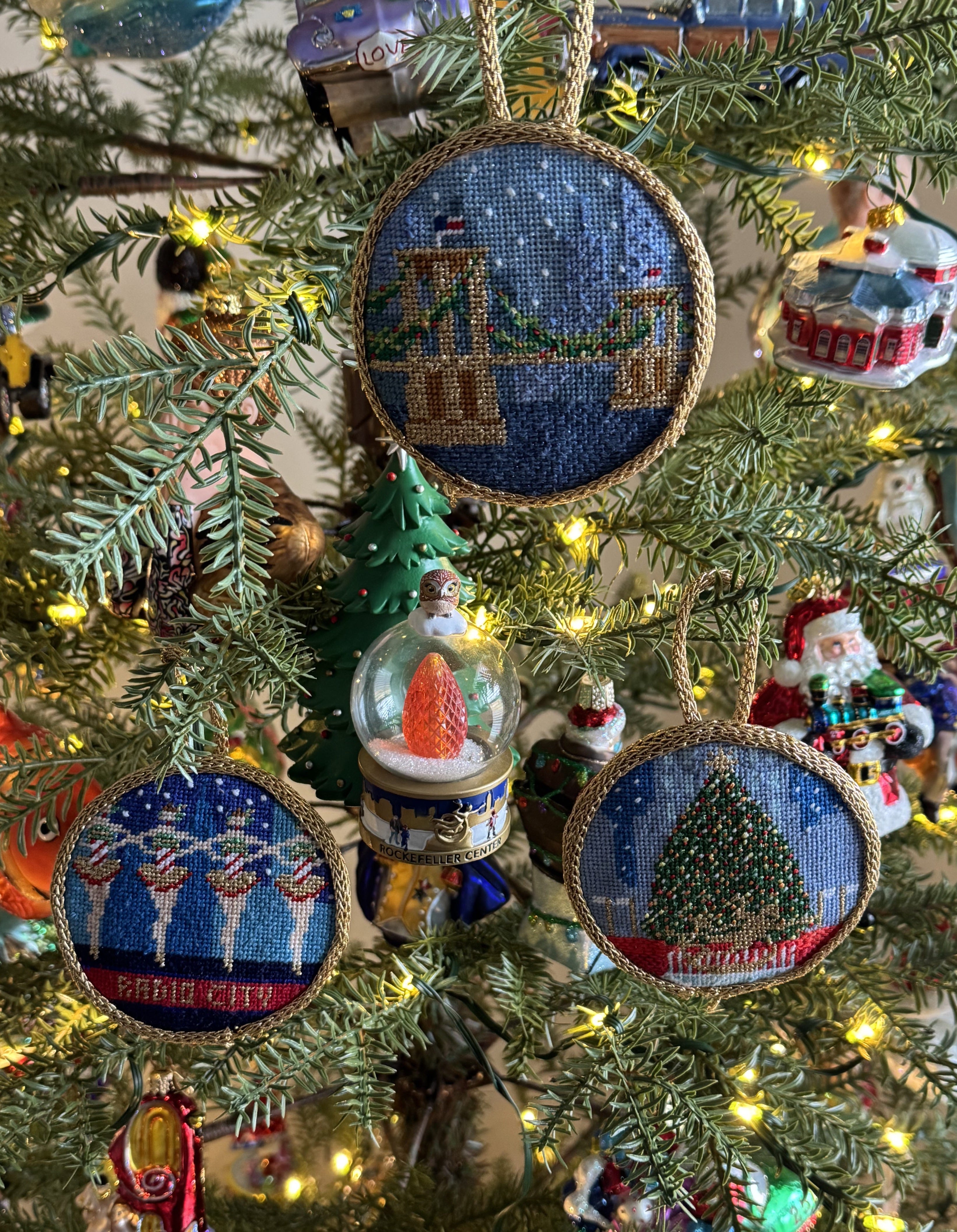
I understood the basics of needlepoint, the terminology, the time, energy, and money that goes into creating one. My mother is a master, and has been stitching all of her life. So, this year, on Black Friday, I ordered 3 needlepoint ornament canvases, each representing parts of our trip to New York - Rockafellar Christmas Tree, Radio City and the Rockettes, and the Brooklyn Bridge, all dressed for Christmas.
They’re a little rough. I can see every errant stitch as soon as I look at them, though I doubt my kids will. By the third ornament, I was using more complex stitches and threads to get the look I wanted. These kinds of gifts take time and planning most people never see—finishing deadlines are usually months earlier—so I finished them myself. Still a little rough. Still worth it. I hope that years from now they’ll recognize the time and love in them, and maybe notice how my work improved along the way.
This year, decorating looked different, too.
There was a time when I treated Christmas like a full-scale production. Magical worlds built room by room. Garland wired into submission. Ornaments curated and themed, rotated like exhibits. I loved it. I don’t regret it. It was an expression of devotion, even if it wasn’t always recognized as such.
Now, I’m more restrained. Not because I love the season less, but because I share it differently. My partner doesn’t celebrate Christmas, and that matters. A department-store-scale transformation would feel less like joy and more like insistence. So I’ve adapted. One room. One tree. More intention. Decorations that invite rather than overwhelm.
It turns out that magic doesn’t require excess. Sometimes it requires respect.
And still, sitting here this morning, I can feel it again. That quiet hum. That sense that something meaningful is happening even when nothing dramatic is occurring. The tree lights glow a little less brightly now that the sun is up. The coffee has cooled. The day will unfold in its own time.
This year feels settled in a way it hasn’t in a long time. I’m starting a new job in January. My divorce is final. I’m happy in my relationship.
It’s good.
Not triumphant. Not resolved. Just good.
If there’s anything this series has taught me, it’s that Christmas isn’t something you preserve intact. It’s something you revise, often without noticing. Traditions fall away. New ones appear quietly. The season keeps offering itself, even when we’re distracted or unsure how to receive it.
This year, I’m receiving it again.
And that feels like enough.
Further Reading
I keep a running collection of books that shaped this project on Bookshop.org.
Purchases there support independent bookstores—and help sustain this work.
Stay Connected
📖 Subscribe to Caleb Reed for weekly chapters and essays.
📸 Follow along on Instagram: @caleb_writes
📘 Facebook: Caleb Reed
🦋 Bluesky: @thecalebreed.bsky.social