



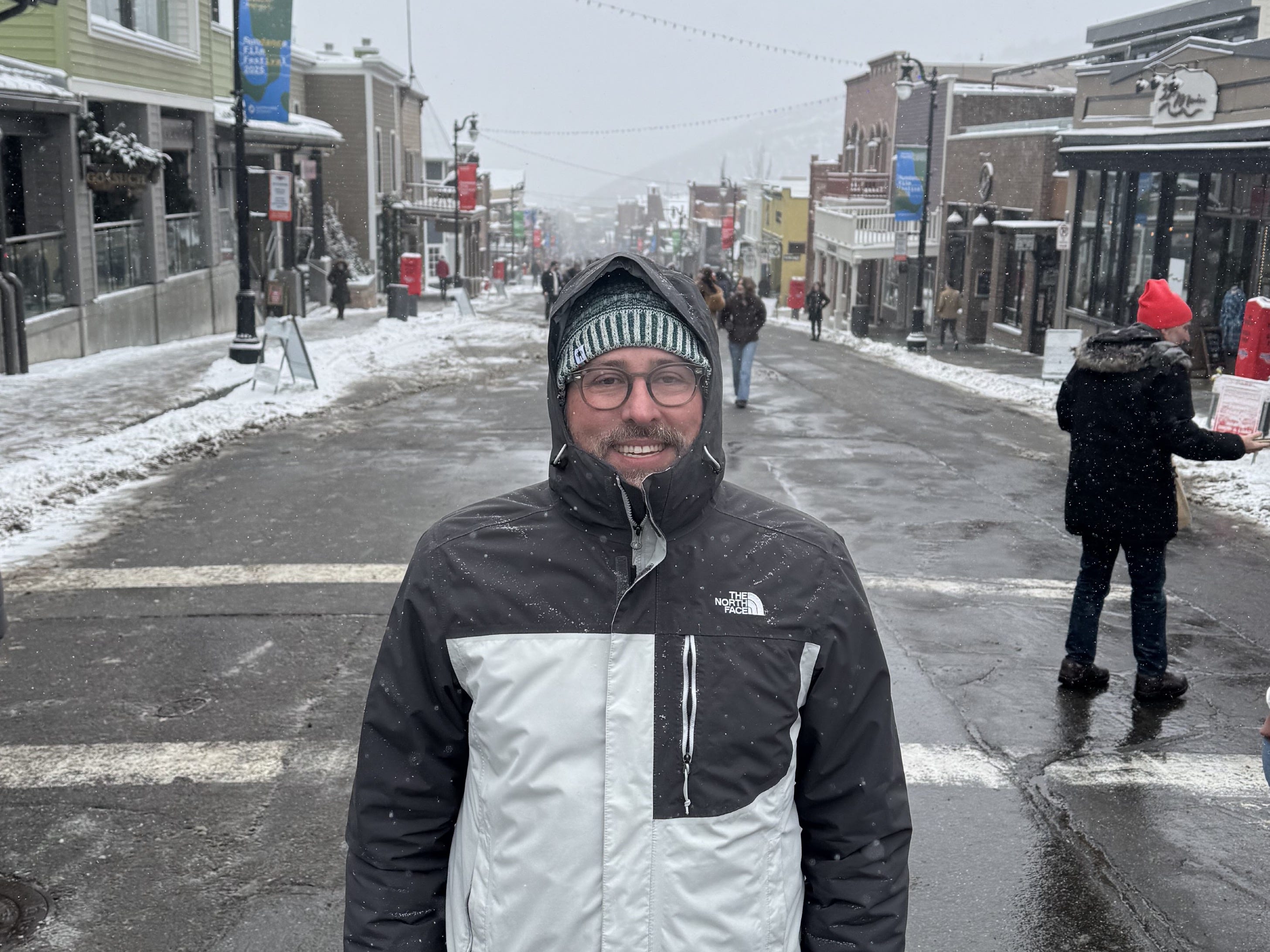
The Sundance Film Festival isn’t romantic in January. It’s wet snow, expensive coffee, and lines disguised as culture. My first time there, last winter, I went with a friend from Richmond. He’d been volunteering at the festival for more than a decade—knew every shuttle, every party, had even met Redford himself. I knew nothing about how the process worked and waited until the last day to register and pick out my tickets. Let’s just say by the time they get to selling individual tickets to the general public, there’s not much left to pick from.
From everything I had read online the one film I wanted to see was James Sweeney’s Twinless. Once in Park City, it seemed like everyone was talking about it, though always in that low, reverent voice people use when they think art has done something dangerous. Of course all showings were sold out.
We never saw it. Did I learn anything from this experience, of course not. Months later, back in North Carolina, I finally watched it alone. And within five minutes I understood what everyone at Sundance had been whispering about, and why it won the Audience Award for best dramatic feature.
Author’s Note: For clarity, I’ve laid out the plot in roughly linear order, though the film itself is not. Twinless folds time in on itself—memories, fantasies, and present moments looping together until it’s hard to tell which came first. It’s only in the final scenes that we realize Dennis was at Roman’s funeral all along, disguised in a wig and sunglasses. The revelation doesn’t rewrite the story so much as confirm what we’ve suspected: Dennis has been haunting the edges from the beginning.
The prelude to disaster
The movie opens with Dennis sitting alone at a restaurant, poking at his food. A woman approaches and asks if anyone is sitting with him. Mistaking it as an invitation, Dennis blurts that he’s almost finished but has nowhere to be. She just wants the chair. The humiliation is microscopic but total, the kind of moment that sets the emotional weather for the film.
Then Rocky appears. There’s nothing coy about what follows. The scenes are graphic and oddly funny; Dennis can’t stop talking, filling the air with chatter about Mary-Kate and Ashley Olsen and his childhood fantasy of a long-lost twin. Even in the middle of pleasure he’s narrating, analyzing, trying to turn intimacy into an idea. The sex isn’t erotic so much as diagnostic. Sweeney uses it to show us a man who has learned to think instead of feel, who covers fear with noise.
By the time the open credits start, Dennis has begun texting Rocky compulsively. When the messages go unanswered, he spirals. The story that follows—Dennis trailing Rocky, the fatal confrontation at an intersection, and the horror that ensues—has the rhythm of inevitability. It’s what happens when loneliness decides it’s owed a witness.
Rocky’s death fractures the movie in two. Everything after is lived in that echo.
The aftermath
At Rocky’s funeral, Dennis sees his twin brother Roman—both played by Dylan O’Brien—and begins orbiting him. What might have started as curiosity becomes mutual recognition. Roman is searching for someone to replace the feeling he once had with his brother—never alone, always paired, a built-in companion for every mundane hour. Dennis wants the same thing, though he dresses it up as fate. The friendship that forms between them isn’t a misunderstanding; it’s an agreement neither says out loud. Roman asks for exactly what Dennis craves: someone who will always be there, someone who won’t leave. What begins as solace turns into dependency, a shared delusion of wholeness.
Sweeney plays Dennis as a man performing stability one tic at a time. He’s meticulous, anxious, always trying to manage the temperature of a room. O’Brien meets him with a kind of exhausted kindness. After years of Teen Wolf and The Maze Runner, O’Brien has never been quieter onscreen. His Roman is all small gestures—polite nods, half-smiles, the restraint of someone afraid that any release might become collapse.
Their connection is believable precisely because it’s uneasy. Each sees in the other what they can’t live without.
Marcie and the unraveling
Dennis unwittingly introduces Roman to his coworker Marcie, played with plainspoken warmth by Aisling Franciosi, who grounds the film. Roman and Marcie fall in love, giving the story its only glimpse of daylight. But for Dennis, the match feels like displacement. He’s given away the one person who made his guilt bearable.
Marcie is the film’s only adult in the room—comfortable with intimacy but unwilling to be consumed by it. She loves Roman but also insists on space, on the right to be alone. For Dennis and Roman, who both equate closeness with survival, her boundaries feel like rejection when they’re really proof of health.
When Marcie discovers Dennis’s deception—the fabricated story about his own long-lost twin, the lies that brought him into Roman’s life—she confronts him. Her ultimatum is simple: tell Roman the truth or she will. The confession scene that follows is pure humiliation. Dennis, trying to delay the inevitable, offers Roman a foot massage, a gesture so wrong it’s almost childlike. When the truth comes out, Roman’s response is brutal and immediate. He beats Dennis and leaves him bleeding in a hotel room.
That violence isn’t cathartic; it’s mercy disguised as rage. It marks the boundary Dennis refused to draw for himself.
The sandwich scene
Time passes—Sweeney doesn’t specify how much. When Dennis and Roman finally meet again, the film’s tone has cooled. Roman is with Marcie now, but the relationship has limits. She’s an only child and doesn’t share his appetite for constant companionship. Roman still longs for the kind of total twin bond he’ll never have again.
In a diner, he and Dennis share a sandwich, an echo of their earlier intimacy stripped of obsession. Dennis tells him, “The only version of myself I liked was the one when I was with you.” Roman doesn’t argue. They both ask for a box at the same time—a tiny synchrony that lands like grace. The movie ends there, refusing to explain what reconciliation means.
What Sweeney built
With Straight Up (2019), James Sweeney made a sharp, neurotic comedy about a gay man afraid of physical intimacy. Twinless inverts that impulse. Here, contact is easy; it’s the aftermath that destroys you. The new film is quieter, meaner, and infinitely sadder.
Sweeney’s Dennis is one of the most precise portraits of loneliness I’ve seen on film. He’s not evil or crazy—he’s desperate. His monologues about pop culture and childhood fantasy are ways to keep silence from swallowing him. When he talks through sex, through grief, through apology, he’s trying to fill the air so he doesn’t vanish.
O’Brien’s dual performance is the revelation. His Rocky is all surface charm; his Roman is the aftermath. He carries the film’s moral weight, proving that empathy and self-preservation can’t coexist indefinitely. Watching him here, you can see the actor shaking off the last of his teen-idol polish.
Sweeney’s direction matches his subject: still, symmetrical, unblinking. The camera often holds just a little too long, forcing you to sit in the discomfort Dennis spends the movie trying to outrun.
The psychology of exposure
The opening’s graphic realism isn’t there to shock. It’s the film’s thesis. By starting with unfiltered physicality, Sweeney shows us the problem before we have time to judge it: Dennis can’t live inside his body. He intellectualizes everything, even desire. The film keeps testing that disconnect—between thinking and feeling, between needing and deserving.
When he kills Rocky by accident, it’s not just a plot turn; it’s punishment for believing intimacy can be manufactured. His later friendship with Roman becomes a form of atonement that neither man understands until it’s too late.
The scene with Marcie is the hinge. She’s the only person who sees through him, the only one who forces honesty. Her ultimatum breaks the film’s illusion and leaves Dennis exposed, literally and emotionally.
The ache underneath
Twinless isn’t about twins at all. It’s about the fantasy of being completed by someone else, and the violence that fantasy invites. Dennis wants what so many queer men are taught to want—a perfect mirror, someone who sees you so clearly that you stop questioning your own existence. But the mirror always cracks.
The film understands that longing without judgment. It’s not moralizing about obsession; it’s showing how easily love curdles into appropriation when loneliness goes untreated. The tenderness between Dennis and Roman near the end isn’t forgiveness—it’s recognition. Two people admitting they can’t save each other, but also that they don’t have to keep pretending.
When I finally turned off the TV, I thought about the night in Utah I should’ve seen it—the crowded streets, the volunteers herding us toward the next big thing. I would’ve watched Twinless surrounded by strangers, all of us trying not to breathe too loudly. Maybe that’s the right way to see it; maybe it isn’t.
Watching it alone felt truer. Sweeney made a movie for the quiet hours after connection, when the phone stays silent and the apartment feels too large.
I’ve known versions of Dennis: men who talk through everything, who use humor as anesthesia, who want to be seen so badly they mistake attention for love. Some days I’ve been Dennis. Other days I’ve been Roman—grateful for affection but terrified of its cost.
What Twinless leaves you with isn’t despair; it’s a reluctant tenderness. The film suggests that the best we can do is meet each other halfway, knowing we’ll fail, and call that mercy.
Sweeney and O’Brien give us a story about obsession, grief, and the impossible math of needing people. It’s also, quietly, about survival—the kind that doesn’t look noble, just human.
Because in the end, connection isn’t cure. It’s evidence. Proof that, for a moment, you were seen. And sometimes that’s enough.
Twinless and Straight Up are currently available for streaming on Amazon Prime - Twinless | Straight Up
Some links may be affiliate links. As an Amazon Associate, I earn from qualifying purchases—at no additional cost to you.
Stay Connected
📖 Subscribe to Caleb Reed for weekly chapters and essays.
📸 Follow along on Instagram: @caleb_writes
📘 Facebook: Caleb Reed
🦋 Bluesky: @thecalebreed.bsky.social