

Twenty Years Isn’t That Long
Reading It’s Not the End of the World and realizing the future isn’t distant—it’s already within reach

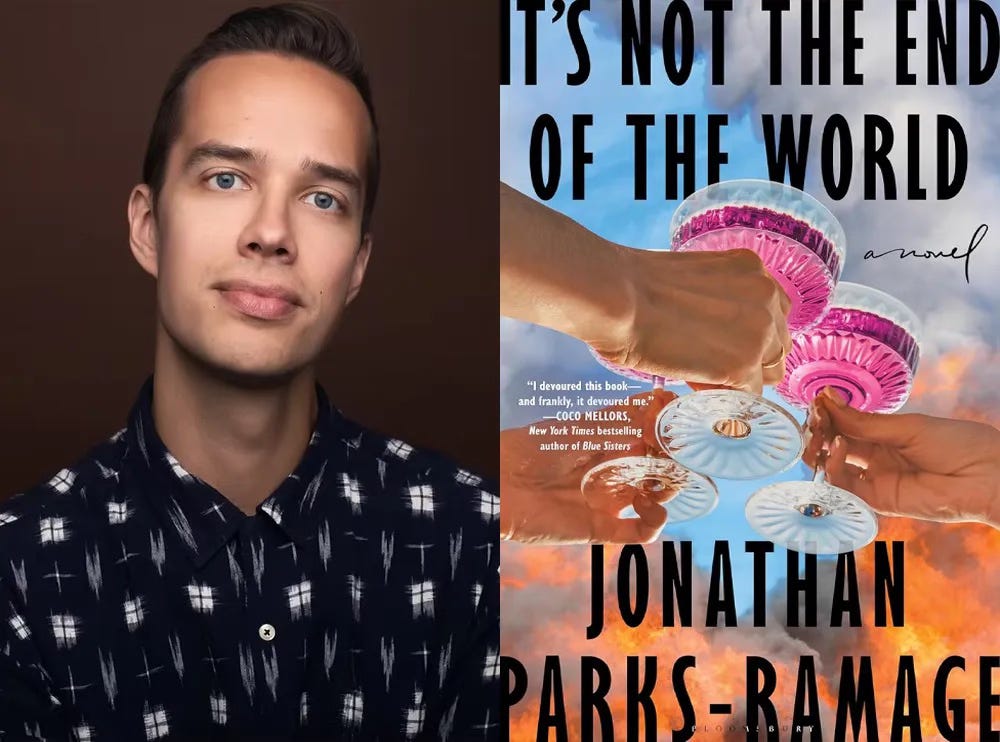
In It’s Not the End of the World, the future doesn’t arrive all at once.
It seeps in.
Set in the 2040s, the novel follows a world reshaped by climate change but still recognizable in its outlines. Parts of the American coastline are no longer fully inhabitable. Cities haven’t disappeared so much as adjusted—barriers, retreat zones, neighborhoods that exist in a kind of suspended compromise with the water.
The air is worse, but not unbreathable. Masks are common, more precaution than emergency.
Life continues.
But not evenly.
The story moves through this world via a network of characters who experience that unevenness in very different ways. A younger generation comes of age inside instability that feels normal to them, while wealthier figures insulate themselves from the worst of it—filtered air, controlled environments, curated versions of reality that keep discomfort at a distance.
Their lives intersect, but they are not the same life.
And the system that holds it all together isn’t neutral.
By this point, government hasn’t collapsed. It’s consolidated. Power has narrowed into something openly aligned with corporate interests and a strain of Christian nationalism that no longer bothers to disguise itself as pluralism. It isn’t presented as a sudden shift. It’s simply what the system has become over time.
Not hidden.
Just accepted.
Running beneath that structure are quieter attempts to live differently. Small, communal groups organized around shared resources, mutual dependence, something closer to family than individualism.
Not radical in theory.
But radical in practice.
Because in a world built on managed isolation and individualized escape, choosing interdependence becomes a form of resistance.
And the response to that resistance is telling.
The state doesn’t ignore it.
It hunts it.
The FBI’s pursuit of these groups isn’t theatrical. It’s procedural. Another system maintaining order. But the implication is hard to miss:
A future that can absorb collapse has very little tolerance for people stepping outside of it.
And then there’s the technology.
Not framed as salvation, but as extension.
For those who can afford it, reality itself becomes adjustable. People retreat into immersive environments—less about fantasy than about control. Memory, experience, identity—all of it becomes something that can be revisited, reshaped, or prolonged.
Not to escape the world entirely.
Just to soften it.
What makes the book unsettling isn’t any single development.
It’s how familiar the logic feels.
Nothing in this future requires a leap.
Just continuation.
What unsettled me most about It’s Not the End of the World isn’t what happens in it.
It’s when it happens.
The book is set in the 2040s.
That used to sound distant. Abstract. The kind of timeline you file away with science fiction and don’t interrogate too closely. Somewhere out there. Someone else’s problem.
But 2044 isn’t abstract anymore.
It’s less than twenty years away.
That’s not a different world.
That’s a continuation of this one.
And at a certain point in your life, that realization lands differently.
It stops being about what your grandchildren might inherit.
It becomes about what you will still be here to see.
What your children will have to live inside.
We’re used to imagining the end of the world as an event. A clean break. Something dramatic enough to mark a before and after.
This book doesn’t offer that.
It suggests something quieter.
What if the world doesn’t end?
What if it just becomes incrementally less livable, and we adapt to each version of it as it arrives?
What if the real innovation isn’t in fixing anything—
but in making it easier not to notice?
The timeline matters because it removes distance.
It doesn’t allow you to dismiss the world it describes as a far-off exaggeration. It places it close enough that you can trace a line from here to there without much effort.
And once you can do that, it’s hard to unsee.
It changes the way you think about progress.
Not as something that moves us forward.
But as something that might simply make decline more comfortable.
There’s a particular unease that comes from realizing that the systems we’re building aren’t necessarily designed to solve problems.
They’re designed to absorb them.
To redistribute their impact.
To ensure that some people feel them less than others.
That’s not a distant future problem.
That’s already true.
The book just extends the logic.
It doesn’t ask whether we’ll avoid that outcome.
It asks whether we’ll notice it happening.
Or whether we’ll adjust, gradually, until it feels normal.
That’s what makes it linger.
Not the scale of the change.
But how plausible it feels within a single lifetime.
Because twenty years isn’t long.
It’s a career.
It’s the difference between raising children and watching them navigate the world on their own.
It’s close enough to imagine.
Close enough to recognize.
Close enough to be ours.
Purchase of copy of It’s Not the End of the World here: Amazon | Bookshop.org
Disclosure: This post may include affiliate links (including Amazon). If you buy a book through one of these links, I may earn a small commission at no extra cost to you. Consider it a small contribution to my ongoing habit of buying too many books and writing about them here.
If you prefer to read on your Kindle, you can purchase Line & Verse, Book 1 from Amazon. Paid Subscribers can also download a copy of the eBook version here.
Stay Connected
📖 Subscribe to Caleb Reed for weekly chapters and essays.
📸 Follow along on Instagram: @caleb_writes
📘 Facebook: Caleb Reed
🦋 Bluesky: @thecalebreed.bsky.social
Great review.
I haven't read this book but have read his earlier novel "Yes Daddy".