


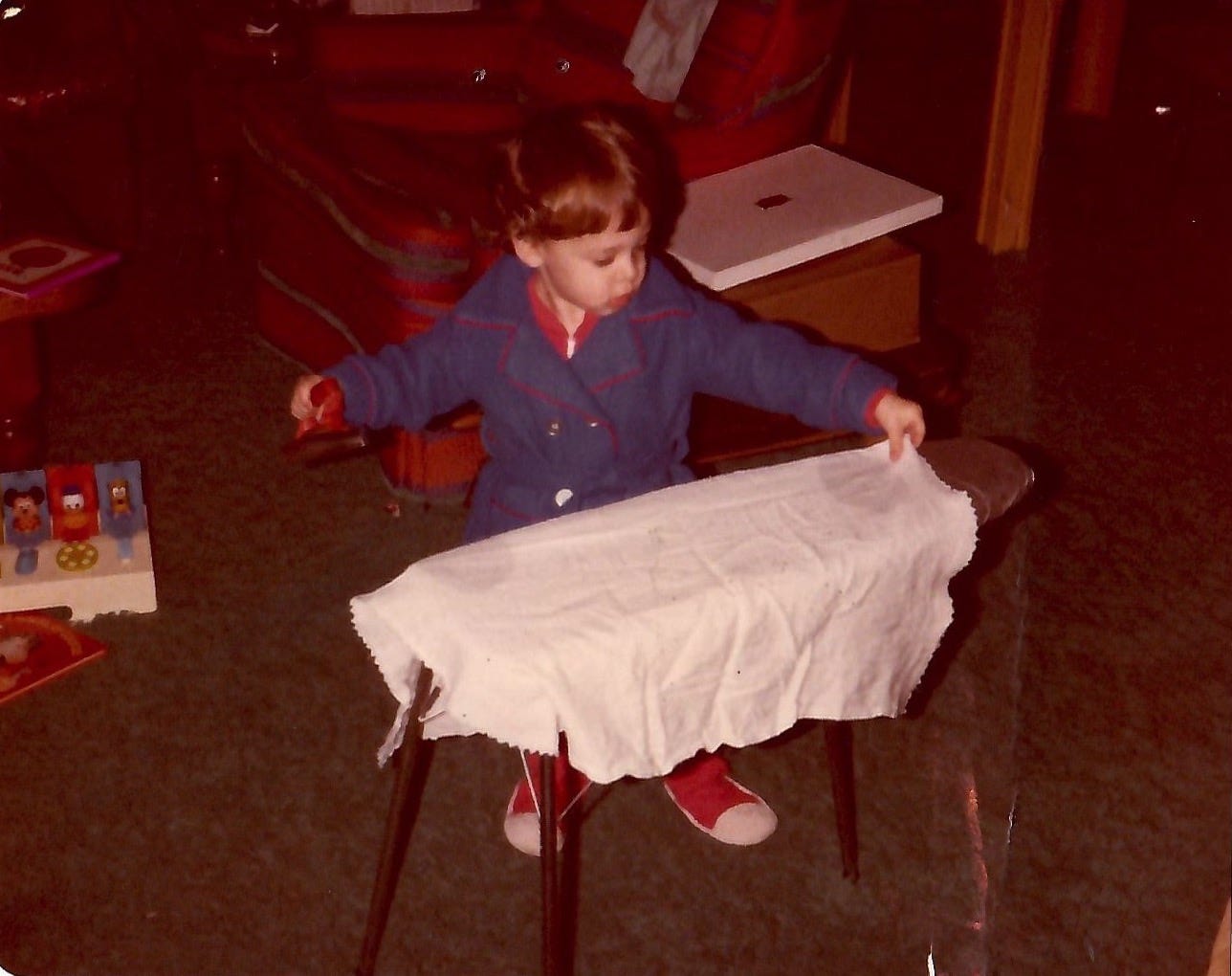
I sometimes think my childhood was measured not in years, but in Christmases. Other kids grew an inch or two each summer; I grew in rings of memory, bright as the lights that filled our house each December. There are people who say memory softens the past, rounding off the edges, smoothing over the real shape of things. Maybe that’s true for me. But the Christmases of my childhood remain vivid, shimmering in my mind with a clarity I’ve never been able to explain away. They were more than holidays. They were whole worlds we stepped into—built, arranged, and animated by the people who raised me.
The smell was always the first sign the world was changing. Not cinnamon or pine in any vague sense, but Aromatique’s The Smell of Christmas, which my mother deployed each year like an incantation. It arrived before the lights, before the garlands, before the boxes of ornaments came down from the attic. She’d place the potpourri in a glass bowl on the coffee table, and suddenly the house shifted. You could taste the scent on the air—a warm, resinous blend of clove and orange that meant the calendar didn’t matter anymore. Christmas had begun.
My aunt lived next door, which made the holiday feel less like a single celebration and more like a compound-wide transformation. She decorated on a scale that would’ve embarrassed a department store. Fake fruit dipped in glitter, garlands that sagged under the weight of ornaments, wreaths so large they looked stolen from the gates of a civic building. And it all began early. October-early. The Time-Life Treasury of Christmas playing through the house before the leaves even finished turning. The Alabama Christmas Album and Dolly Parton and Kenny Rogers snuck in by Halloween. By Thanksgiving, her house was fully awake. To this day I know every word to every song on those first two albums.
If my aunt built maximalist magic, my grandmother provided the quiet scaffolding beneath it. She didn’t perform Christmas in the obvious ways—no loud decorations, no glittering garlands—but she made space and provided for it all to flourish. Christmas wouldn’t have happened without her, and in a way, she remains the person I think of when the season settles into its softer, more tender places.
But the heart of it all—the architect of our most spellbinding Christmases—was my mother. She was a florist, which meant she knew how to work with native greenery the way other people work with words. She would come home in early December with armfuls of pine garlands, cedar branches, magnolia leaves, and smilax that seemed to stretch on forever. She tied bows with a precision and beauty that looked easy until you tried to copy it. The house would fill with the scent of sap and cold greenery, with ribbon, floral wire (I promise you it has its own smell), pinecones, and the hush of focus that fell over her when she was making something beautiful.
If she needed materials that couldn’t be purchased, my father and I would go out searching for them. These weren’t simple errands. These were expeditions. We’d drive into the national forest or around our neighborhood - which was mostly untouched woods at the time. The cedar had to have the little blue berries on it, the “right” magnolia without the waxy leaves. Unfortunately, my yard today has the cedar, but the “wrong” kind of Magnolia. My father would haul the cut branches over his shoulder, and I’d carry the lighter pieces, proud to be part of the effort. These outings held a quiet magic of their own—a father teaching his son what devotion looks like, not in words, but in the simple willingness to gather what someone you love needs in order to create something beautiful.
My mother had an artist’s eye but also a merchant’s instinct. For a time, she sold Christopher Radko ornaments in her shop—the proper, hand-blown kind whose sparkle is unmistakable. Radko ornaments didn’t just hang on trees; they transformed them into jeweled mosaics. She discovered them in New York in the early 80s and began collecting them. We had a lot of his first ornaments on our tree—the whole Twelve Days of Christmas set, eventually—and they came out each year with the kind of reverence some families reserve for heirloom silver. She never scolded me for touching them. She handed them to me freely, trusting the care I had even as a child. And when my sister and I begged for our own small trees in our bedrooms, she decorated those, too, with miniature glass ornaments bought on our annual trips to Calabash.
Calabash, North Carolina, was not known to us for its shrimp boats or seaside tchotchke shops. For us, it was known for one particular Christmas store - Callahan’s Nautical Gifts. At first glance you would assume it to be like every other Myrtle Beach gift emporium. Of course they had saltwater taffy and that stuff, but the bulk of the store was devoted to Christmas decorations. A Department 56 “Snow Village” laid out in the largest display I had ever seen. Blown glass ornaments, Byer’s choice Carolers, you name it and they had it.
We’d also go to Charlotte, NC mostly to visit Southpark Mall and the specialty shops that my mother and aunt had discovered visiting my great-grandmother. Even after a “new” way to Charlotte was possible via 4 lane highways, we still went the old way - passing through dozens of little SC towns I can still rattle off today. On the way my mother would stop for dollhouse miniatures for my sister, who owned a beautiful wooden dollhouse that grew more elaborate with each passing year. They bought tiny lamps, porcelain dishes, wreaths the size of quarters. I, too, benefited from these excursions. My mother found plastic garlands and dollhouse-sized wreaths to decorate my LGB train set. One year, she even made the wreaths herself, twisting the green material with wire and trimming them with red bows so small they looked like they belonged on a fairy’s front door.
The train was my pride. Still is. An LGB set from West Germany, purchased before the Berlin Wall fell, engineered with a level of craftsmanship that has kept it running strong for decades. The station, a kit she bought somewhere near my grandparents mountain home, came with instructions entirely in German, which I assembled through sheer willpower and intuition. I still have the train today, circling my own Christmas tree 40 years later.
Summers in the mountains were spent haunting every Christmas shop in the High Country—Boone, Banner Elk, Linville—searching for additions to our winter worlds. These stores weren’t the tourist attractions they are now. They were small, warm, undiscovered places tucked into mountain towns, smelling faintly of wood and wool and dusty shelves. Run by locals or retirees to the area, open only in the summer. One of them is where she found my train. Today the shop is a rafting place.
The magic of those High Country summers carried straight into December. My sister and I would set up our tiny trees with our tiny glass ornaments; my mother would shape the house with greenery and garlands; my aunt’s windows would glow next door. The world around us felt transformed, as if our small town had been chosen for something extraordinary.
Sometimes, I was so overwhelmed by excitement on Christmas Eve that I threw up. Not from sweets or nerves or too much motion, but from anticipation that became too large to hold inside my small body. Other kids counted presents. I counted worlds—tiny ones under the tree, bigger ones outside the window, worlds made of lights and music and needlepoint stockings. I wasn’t greedy. I was overwhelmed by wonder.
And the wonder was not abstract. It was embodied in the people around me. One year, my father and his uncle built a playhouse for us. Not a pre-fabricated thing bought from Lowe’s, not a hand-me-down play set assembled with an Allen wrench. They stick-built it on Christmas Eve, hammering and sawing through the night in the cold while my sister and I slept. My mother told us Santa’s elves had borrowed my father’s tools. I believed her. Part of me still does.
Christmas magic in our house wasn’t something purchased—it was something constructed, conspired, and lovingly engineered by the people who raised me. When I look back now, the most extraordinary part isn’t the objects themselves, but the lengths to which my family went to make December feel like stepping into another world. With Amazon Prime, eBay, Facebook Marketplace, you can find and have shipped to you nearly anything. Not so then. We circled what we wanted in the Sears “Wishbook.” My mother, grandmother, aunt, all made phone calls to find that year’s latest toy. Friends haunting their own local stores trying to find the things on her list. I’m certain she brawled with other moms to get Cabbage Patch dolls, or the GI Joe men. My great-grandmother, oblivious to all the hype, would dutifully wait in line to pick up things for her well into her 90s.
One of the most legendary examples was the year of the GI Joe aircraft carrier. Not the later versions kids could find on eBay, but the original—seven feet long when assembled, the holy grail of 1980s toys. You couldn’t walk into the Kmart in my small hometown and buy something like that. There was nothing on the shelves that could hold that kind of wonder. My mother found found it in Charlotte, and my great-grandmother and my grandfather loaded the unassembled box into the trunk of her Cadillac Seville, the one with the two-tone paint and carpeting so plush it felt like stepping into a coat of fur. It even had a CB radio.
The box fit perfectly into that long, square-backed trunk—almost as if the Cadillac had been designed for it. That absurdity still delights me. You could never fit something like that into a modern sedan. Christmas Eve, after we’d been sent to bed, my older cousin and his best friend stayed up into the small hours assembling it—hundreds of pieces, tiny struts and platforms, stickers, compartments, ladders. They worked in secret under dim garage lights so that I would wake to a fully realized world.
And I did. Every year.
That carrier was the closest thing to waking up inside FAO Schwarz without ever having stepped foot in one. People ask why I threw up every Christmas Eve. This is why. Reality never stood a chance against the world my family built.
The aircraft carrier year is also bound up in another memory: the house full to bursting. Every December, my great-grandmother and her sister came to stay for a week or two. Our house rearranged itself to make space. My great-grandmother slept in my sister’s room; my sister slept in my room, taking the top bunk; and I, in the bottom bunk, tried—and failed—to fall asleep on Christmas Eve. I’d climb quietly down the ladder every so often to throw up from sheer, overwhelming anticipation, trying not to wake anyone. My sister pretended not to hear. My great-grandmother was deaf as a post. She also woke every morning at 5:00 am, except Christmas morning. We’d all be up waiting for her to open presents muttering to ourselves, wondering why of all days, she chooses this one to sleep in.
But it wasn’t just the big gifts or the full house that made Christmas what it was. It was the way the season called forth talent from every corner of the family.
My father was in charge of the tree, getting it home, storing it and taking care of it until it was time to bring it inside. We had an old, steel Christmas tree stand that my great grandfather had made. It weighed a ton and had 8 “L” bolts that had to be hand cranked into the trunk of the tree. Though it could hold a 12 ft tree easily, the opening circumference was comically small. My father would start by sawing a ring around the trunk to match the depth of the stand, then slowly chip away at the bottom with a hatchet. Finally, my uncle, a machinist, copied the original with a much wider opening. Once he got it in the house, his part was done.
When I was in high school, it was determined that I was old enough to be trusted with choosing the tree myself. The nursery owner and I didn’t discuss price—he knew my mother was good for it, which was its own kind of unspoken Southern code. I remember standing beneath the towering branches, unable to see the top from where I stood, feeling the same thrill I’d felt the first time I saw the aircraft carrier. When they delivered it, it required a full rearrangement of the living room to make space for the tip to brush the cathedral ceiling.
My mother was furious.
The cost, the scale, the logistics—and perhaps most of all, the fact that with the tree pulled into the center of the room, we could no longer hide the “ugly ornaments” in the back.
For all her elegance—her florist’s instinct, her Radko displays, her love of fresh cedar and magnolia—she adored colored lights. Tiny, glowing bulbs in every shade. She liked them cheerfully messy and unapologetically bright, a detail that would have horrified some of the women she knew, but she held to her preference with the kind of genteel stubbornness that suggests a lineage of women who knew their minds and saw no need to apologize for them. That year I think I made 3 trips to Wal-Mart to buy more lights to finish it.
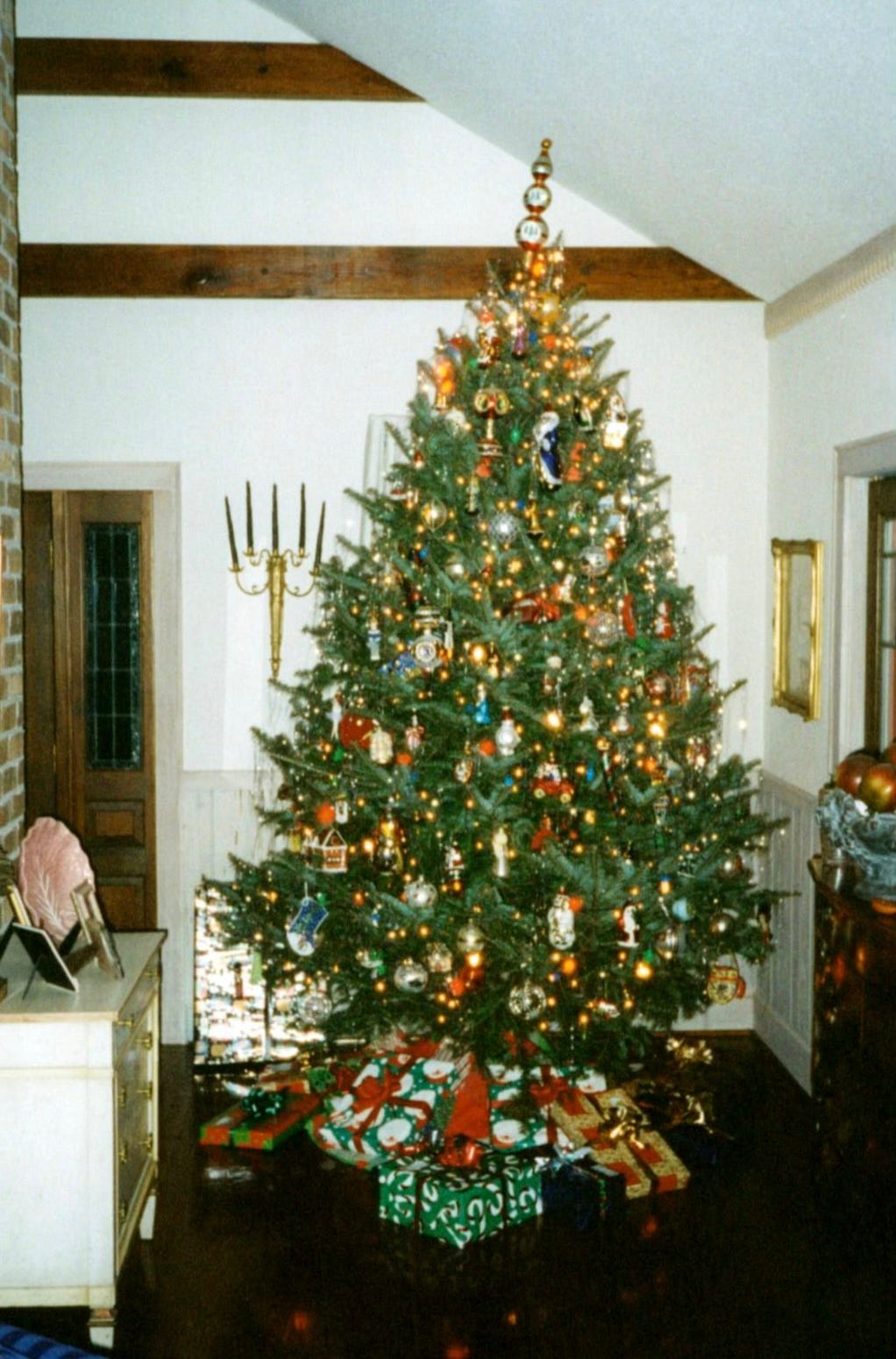
As I grew older, she began entrusting me with more of the decorating. First the tree, then the Snow Village and other decorations she had collected over the years. I didn’t realize then what a gift this was. In some families, children are told not to touch the tree. In ours, I was permitted to shape it. To arrange it. To build it into something like the worlds in my imagination. I eventually convinced her to let me add white lights to the tree, to “brighten it up.” It was one of the few times in my childhood when no one questioned why I cared so much about beauty or where I placed each detail. It was December. Everyone was allowed to care.
All these details—my aunt’s maximalism, my grandmother’s quiet stewardship, my mother’s artistry, my father’s greenery expeditions, my great-grandmother’s presence, the ingenuity of my uncle’s tree stand—wove together into a childhood where Christmas felt less like a holiday and more like a place we lived in. A season built by many hands, with a kind of devotion that today feels almost impossible. It was a world where beauty was allowed, where wonder wasn’t mocked, where the effort to create something magical was simply part of who we were.
And in that world, I learned something quietly, without realizing it:
Christmas was the first place where I felt the inside of myself match the outside.
A place where caring wasn’t suspect, where arranging wasn’t unusual, where light and color and music felt like the most natural language in the world.
A place where I belonged without apology.
As I got older, the magic changed shape, as all magic eventually does. Childhood wonder gives way to adolescent self-consciousness, and yet Christmas—somehow—remained the one place untouched by that shift. It stayed bright. It stayed whole. It stayed mine.
Not because the world outside softened, but because the world inside those December walls had already been built so solidly, so lovingly, so convincingly that I could walk back into it each year like stepping into a memory that still breathed.
The older I grew, the more Christmas began to feel less like something done for me and more like something I was being invited to participate in. My mother didn’t script that transition; she simply allowed it. She’d stand beside me at the tree and hand me an ornament—one of the Radko pieces, usually—and say, “Find the right spot.” And she meant it. She trusted me to know.
I don’t think she ever understood what that trust meant, or how rare it was. In the world we lived in—Southern, traditional, quietly prescriptive—boys weren’t often encouraged to express feeling through arrangement, or beauty, or attention to detail. Boys were allowed to hang lights, perhaps, but not to care about how they hung. Not to feel something meaningful come alive in the placement of a wreath or the drape of garland or the soft, glowing symmetry of a well-balanced tree.
But I cared.
And in December, no one questioned that impulse.
Beauty wasn’t coded. It wasn’t policed. It was simply allowed.
I didn’t yet understand that this was a kind of early self-expression.
I didn’t understand that in other months, the same instincts could be misread or judged or tucked away.
All I knew was that for a few weeks each year, I felt entirely at home inside myself.
My mother would decorate with abandon—magnolia leaves and cedar branches and smilax gathered by my father. The house would glow. My aunt’s house next door would glow too, though in a different register—maximal, glittering, unapologetic. “More is better” being her motto. My great-grandmother would move quietly through our house, observing, assisting, adding that subtle layer of presence only elders can offer.
And I, entirely unaware of the deeper currents shaping me, absorbed it all.
I learned how a space could feel festive or warm or reverent.
I learned that beauty is a form of care, and that care is a form of love.
I learned that the world could be transformed—not in grand, sweeping gestures, but through small, intentional acts done again and again with devotion.
But the thing that stayed with me most was the world of Christmas morning.
By the time I reached the age where I began to notice the limitations of the real world—the rules and expectations, the unspoken boundaries of what boys could do or love or say—Christmas morning remained untouched. In that room, surrounded by the glow of colored lights, with the tree towering toward the ceiling and my LGB train circling below, I felt a kind of alignment I didn’t experience anywhere else.
It was the feeling of being allowed to feel.
The feeling of being allowed to show delight without restraint.
The feeling of being understood without needing to explain myself.
My great-grandmother and her sister, sitting in robes at the table with coffee.
My mother moving through the living room, fixing a ribbon here, straightening an ornament there.
My sister squealing over a new doll or toy.
My father, quiet and steady in the background, garbage bag in hand, proud without needing to say so.
My aunt next door, blasting Time-Life Christmas before noon.
My train running its soft, steady loop, as if reminding us that wonder has its own rhythm, circular and eternal.
If you’d asked me then why I loved Christmas so much, I would’ve had no answer except to say, “It’s Christmas.”
But now, with the distance of years, I know the truth:
Christmas was the one place in my childhood where I never felt the need to hide anything.
Not my joy.
Not my care.
Not my sensitivity.
Not my imagination.
It was the season that taught me beauty wasn’t frivolous—it was meaningful.
It was the ritual that taught me expression wasn’t weakness—it was connection.
It was the room where I first learned how to breathe.
Sometimes I think the reason I was sick with excitement every Christmas Eve wasn’t because of presents or anticipation, but because my body knew what my mind didn’t yet have words for:
This was the world where I felt most fully myself.
And the possibility of stepping into that world again was almost too much to hold.
In the years that followed, life would grow more complicated. Identity would become something I learned to manage, then suppress, then carefully excavate again as an adult. But Christmas—those childhood worlds—remained untouched by that process. They remained the blueprint of something true.
When I look back now, what stays with me isn’t the GI Joe aircraft carrier or the twelve-foot tree or the train looping under the branches. It isn’t the Radko ornaments or the Snow Village or the greenery that perfumed the air.
What stays with me is the feeling.
The hush before the lights were plugged in.
The soft, slow wonder of a house transformed.
The sense that magic wasn’t something found—it was something made.
And even now, decades later, whenever that first December chill arrives and the light shifts across the floor in that particular winter way, I feel the faintest echo of the child I once was—wide-eyed, sleepless, trembling with anticipation—not because of gifts or spectacle or surprises…
…but because Christmas was the first time I ever saw a world that matched the one inside me.
And that kind of magic never really leaves you.
There’s a song on the Alabama Christmas album called “Santa Claus (I Still Believe in You).” It’s pure mid-80s country Christmas — sentimental, earnest, a little syrupy — but the heart of it has always stayed with me. The chorus talks about how even grownups carry a child inside them who still wants to believe, still sees magic in the glow under the tree. And that’s exactly what Christmas is for me: the one season where the kid I was could meet the adult I became, with wonder still intact.
Stay Connected
📖 Subscribe to Caleb Reed for weekly chapters and essays.
📸 Follow along on Instagram: @caleb_writes
📘 Facebook: Caleb Reed
🦋 Bluesky: @thecalebreed.bsky.social