


I picked up Palaver intending to read it immediately.
Instead, I paused.
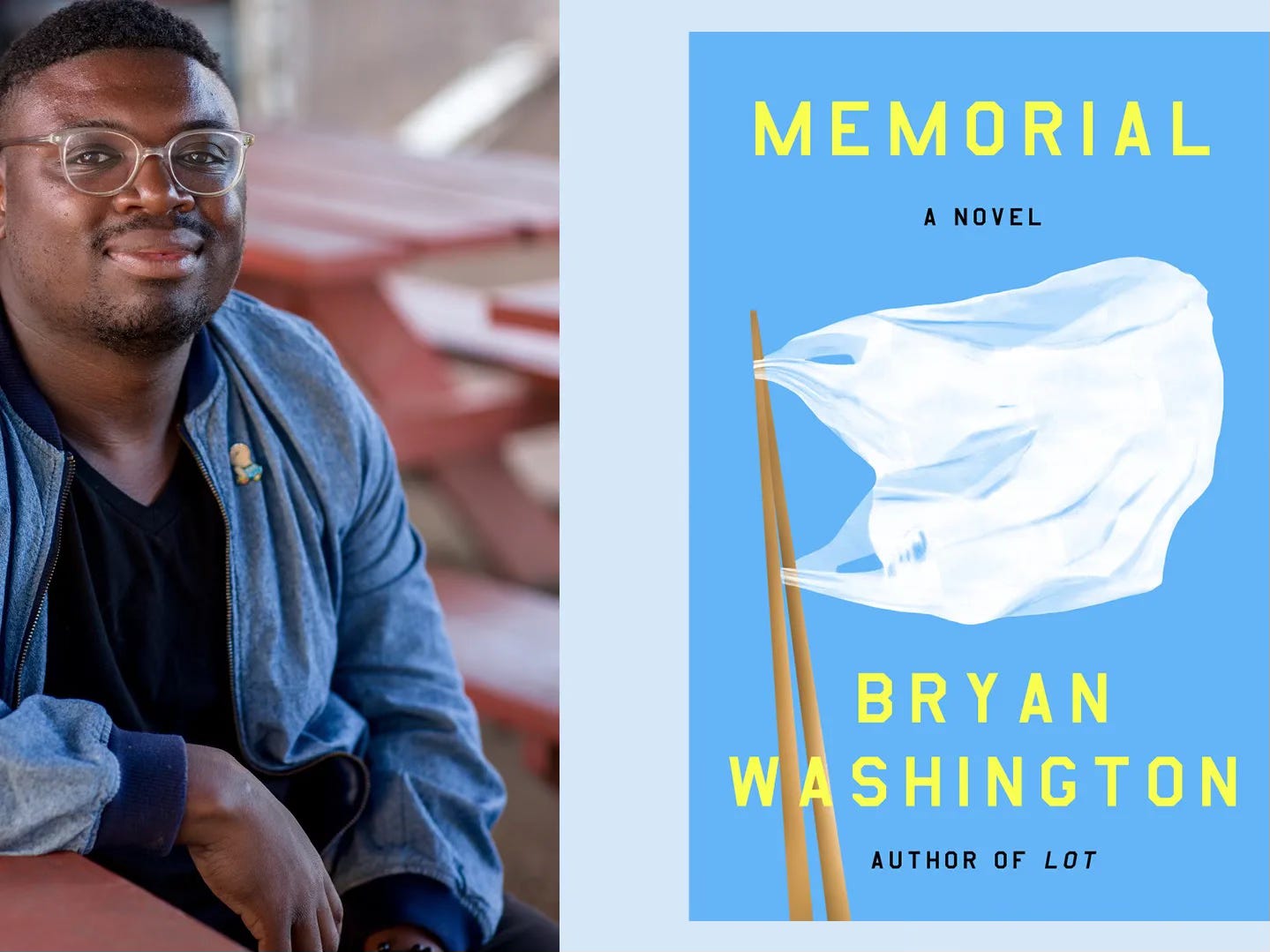
Not because anyone told me I had to, exactly, but because enough people seemed to agree that if I was finally going to read Bryan Washington, I should probably start where most people start: Memorial.
This was mildly annoying.
I had a plan. I wanted to read the new book. I had already decided what I thought the week’s essay might be. Humans are forever under the illusion that reading happens according to schedule, as though books care what we intended.
So I started Memorial first.
And then promptly got absorbed.
Not in the way certain novels absorb you through plot. There are books you inhale because something dramatic is always happening. Secrets revealed. Relationships detonating. Lives collapsing on schedule every forty pages.
Memorial works differently.
The novel follows Mike and Benson, a couple in Houston whose relationship has quietly drifted into something strained, familiar, exhausted. Mike leaves unexpectedly for Japan to care for his dying father. Benson stays behind.
Except he doesn’t stay behind alone.
Mike’s mother, Mitsuko, arrives for a planned visit and despite Mike’s absence, she ends up living with Ben.
On paper, this premise sounds like the setup to a comedy of misunderstandings or some emotionally explosive domestic drama. It could easily become a book of dramatic confrontations, withheld truths, and eventual catharsis.
Instead, Washington does something much harder.
He trusts silence.
More specifically, he trusts what people do when they cannot yet say the thing they mean.
That, I think, is what stayed with me.
The tension in Memorial rarely arrives through arguments. Not really. It arrives through omission. Through pauses. Through meals prepared or avoided. Through ordinary acts of care that feel too intimate for people who no longer quite know how to be close to one another.
Food becomes emotional language.
Domesticity becomes emotional language.
Absence becomes emotional language.
Mike and Benson are constantly communicating, even when they aren’t communicating at all.
That feels truer to life than most fiction is willing to admit.
At twenty, I probably wanted relationships in books to declare themselves. Love announced through confession. Estrangement solved through confrontation. Emotional clarity arriving in a scene dramatic enough to justify itself.
By middle age, life starts teaching different lessons.
Most relationships do not fail in spectacular ways.
Most families do not heal through revelation.
People disappoint one another gradually. Love changes shape quietly. Resentment accumulates through small omissions rather than singular betrayals.
And repair, when it comes, rarely announces itself.
That is what Washington seems to understand.
Memorial is not interested in transformation so much as movement.
Benson changes, though subtly. Left with Mitsuko, he is forced into a strange kind of reluctant intimacy. Caregiving sneaks up on him. Routine sneaks up on him. The awkwardness of proximity slowly becomes something softer.
He doesn’t suddenly become healed or emotionally articulate.
He simply becomes less defended.
Mike changes too.
His trip to Japan forces him toward the kind of unfinished family business most people spend years avoiding. The relationship with his father remains complicated, strained, imperfect. But something shifts in the effort itself.
He shows up.
That matters.
Not because it fixes anything.
Because in real life, things are rarely fixed.
They are moved.
And maybe that distinction explains why I found myself thinking about Memorial long after I finished it.
Or why, before I had fully processed it, I immediately picked up Palaver.
And strangely, Palaver helped me understand what Washington had been doing all along.
Because while the books are different, they seem fascinated by the same question:
How do people who struggle to speak honestly still manage, imperfectly, to love one another?
Palaver stayed with me for a different reason.
The ending.
Not because it was dramatic.
Because it wasn’t.
The conflict resolves, but quietly. Subtly enough that I almost missed what Washington was doing at first.
No grand speech.
No impossible reconciliation.
Nobody suddenly becomes a different person.
Instead, something shifts.
The son answers his mother’s call.
Communication with his brother quietly reopens.
People stop moving away from one another and begin, cautiously, moving back.
That felt oddly perfect to me.
Because conflict in real life rarely resolves the way it does in movies or television.
No swelling music.
No cathartic monologue.
No impossible emotional fluency where everyone finally says exactly what they mean at exactly the right moment.
Life is messier than that.
People stay wounded.
Families remain complicated.
Old hurts do not disappear simply because someone is suddenly ready to discuss them.
But sometimes, healing looks smaller than we expected.
Sometimes it looks like answering the phone.
Further Reading
Memorial - Bryan Washington: Amazon
Palaver - Bryan Washington: Amazon
Disclosure: This post may include affiliate links (including Amazon). If you buy a book through one of these links, I may earn a small commission at no extra cost to you. Consider it a small contribution to my ongoing habit of buying too many books and writing about them here.
If you prefer to read on your Kindle, you can purchase Line & Verse, Book 1 from Amazon. Paid Subscribers can also download a copy of the eBook version here.
Stay Connected
📖 Subscribe to Caleb Reed for weekly chapters and essays.
📸 Follow along on Instagram: @caleb_writes
📘 Facebook: Caleb Reed
🦋 Bluesky: @thecalebreed.bsky.social
I can totally see that – and his way to trust silence is something I really appreciate about Bryan Washington!
I couldn’t put either of these books down! I am definitely a fan now❤️