

The Advent House and the Gospel of John Hughes
Christmas, Family Longing, and What John Hughes Understood About Trying Too Hard

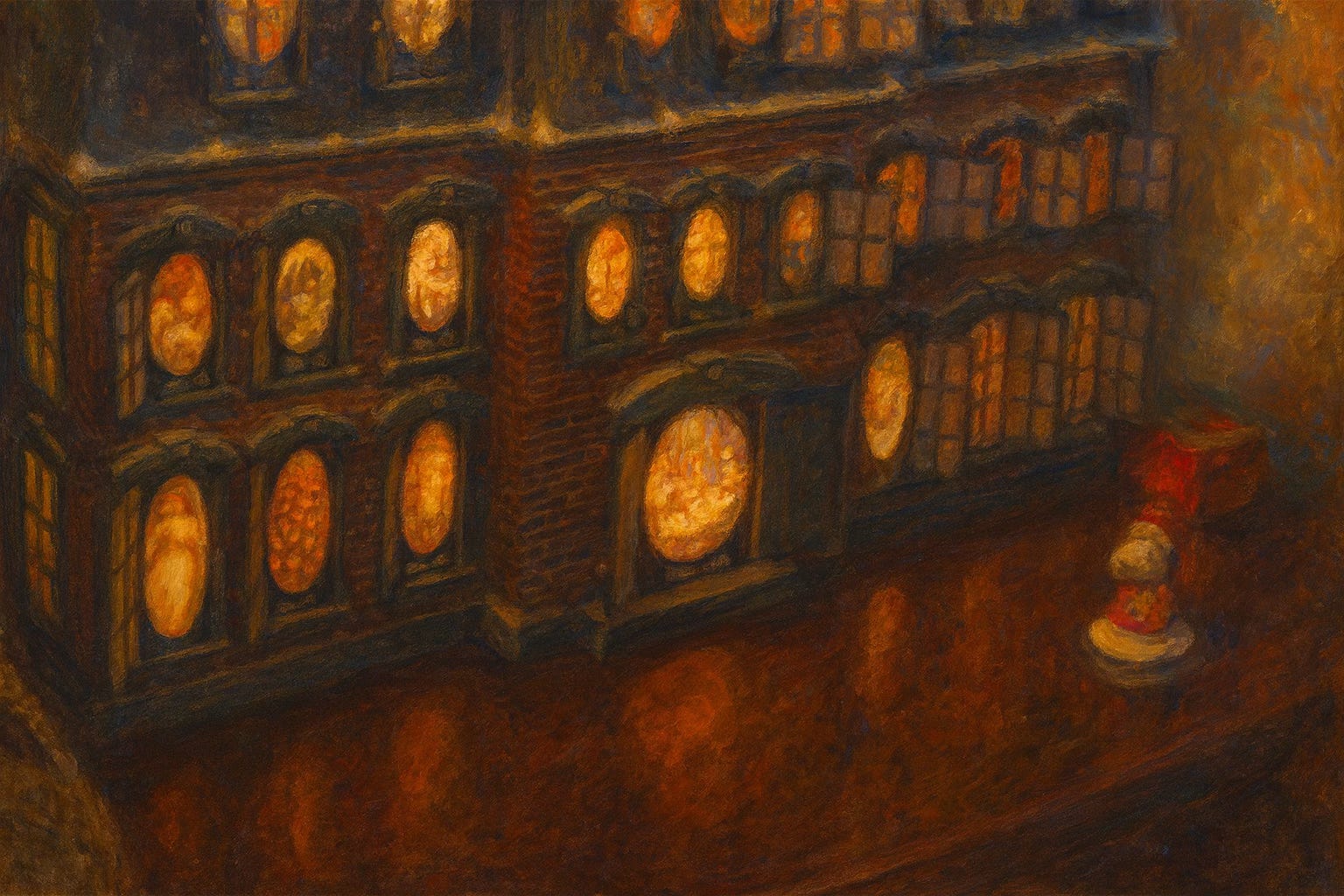
I grew up inside two Christmases.
One was the world my family built. Smilax pulled from the woods and wired into submission. Colored lights blazing from every surface. Radko ornaments catching fire in the glow. Elders drifting through the house like benevolent ghosts, appearing suddenly with trays or opinions. My aunt launching the season sometime in October, whether the calendar approved or not.
That Christmas was sensory, generational, handmade. It smelled like Aromatique and cedar and floral wire and the faint metallic heat of light bulbs that had been plugged in too long. It was loud. It was overdone. It was earnest. It assumed, without question, that Christmas was something you did, not something that merely arrived.
Preparation was the point. Excess was the language. If you weren’t exhausted by December 24th, you hadn’t taken it seriously enough.
The other Christmas lived on the screen.
It was written by John Hughes.
And the older I get, the more I realize how astonishingly those two worlds mirrored each other. Comedically. Chaotically. Tenderly. Accidentally. As if the Griswolds were running a parallel simulation of my childhood just a few states north, populated by different furniture but governed by the same emotional physics.
Hughes understood something I wouldn’t have language for until adulthood:
Christmas is the season when the entire family system rises or collapses under the weight of its own longing.
And National Lampoon’s Christmas Vacation may be the purest expression of that truth ever put on film.
It was supposed to be silly.
But it was also, somehow, a documentary.
The Gospel According to John Hughes
People often misremember who actually wrote the early National Lampoon vacation films. Harold Ramis, an original Lampoon founder, looms large in the mythology, and rightly so. But he didn’t write the first three movies. Those scripts—Vacation, European Vacation, and Christmas Vacation—came from John Hughes.
Hughes, patron saint of American nostalgia and suburban emotional truth, understood families the way botanists understand ecosystems: every moving part connected, every dysfunction rooted in love, every ridiculous incident growing out of something tender and unresolved. He understood that nothing truly absurd happens inside a family unless something sincere caused it first.
Who else could have created Clark Griswold, a man undone not by selfishness, but by devotion?
Hughes also understood the holiday myth better than anyone:
The optimism.
The chaos.
The yearning.
The fear that this year won’t live up to the last.
The belief that the perfect Christmas will fix what daily life cannot.
Christmas, in Hughes’s universe, is not a reward. It’s a test.
It asks families to perform themselves at maximum intensity. To compress memory, tradition, obligation, resentment, hope, grief, and joy into a narrow window of time and pretend this compression is festive rather than dangerous.
And Hughes wrapped all of that in slapstick so the truth wouldn’t sting.
The turkey explodes so we don’t have to talk about disappointment.
The cat electrocutes itself so we don’t have to talk about exhaustion.
The lights fail so we don’t have to talk about how badly Clark needs this to work.
Hughes built Christmas universes on film the same way my family built them at home: through excess, earnestness, and an absolute refusal to give up on the idea that magic could be engineered through brute force and goodwill.
Nothing in Christmas Vacation is accidental. Not the clutter. Not the noise. Not the endless procession of relatives. Not the way every good intention becomes another logistical problem.
Hughes wasn’t mocking Christmas.
He was defending it.
The Griswolds: My Accidental Cinematic Cousins
The Griswolds were, in their own way, us.
Not exactly. My mother never turned a turkey into a geological specimen, and my father didn’t grease a sled with experimental lubricant. But the emotional beats were identical.
Old people coming to stay.
Kids sharing rooms.
A house suddenly overfull and unmanageable.
A parent who wanted, desperately, to make it perfect.
In our world, my great-grandmother and her sister arrived each December with enough luggage to make you wonder when they actually planned to leave. Beds shifted. Rooms rearranged. The house expanded like a lung. Privacy dissolved. Hallways became thoroughfares. Everyone learned to knock with their voices instead of their hands.
This woman, who woke at five every morning of her life, chose Christmas morning as the exception. My sister and I whispered in the living room, muttering WHY TODAY? while adults negotiated reality under their breath.
Clark Griswold would have understood.
And then there were Rusty and Audrey, recast for the third time with no explanation, no apology, and no continuity. We got Juliette Lewis, already exhausted beyond her years, and Johnny Galecki, still soft with childhood. We accepted them instantly, because Hughes never asked us to believe in the Griswolds’ faces.
Only their energy.
That was always enough.
We once amputated the top of my aunt’s Christmas tree because it was too tall for her living room. She shrugged and called it her “Christmas shrub,” as if nothing catastrophic had occurred. No mourning period. No apology. Just immediate narrative control.
John Hughes couldn’t have scripted a better visual joke.
It’s a Wonderful Life played endlessly in the background, just as it does in the film, because in the eighties it ran so continuously that it felt less like a movie and more like a hostage situation. Hughes wasn’t exaggerating. The film became part of the architecture of December.
In my family, the cast didn’t change, but the roles did. One year you were assigned stockings. The next, greenery. The next, full orchestration of the Snow Village. December was its own annual recasting, each of us stepping into new parts as the years required.
That’s Hughes’s real genius. Everyone sees their own family in Christmas Vacation. Not in the details, but in the energy. The chaos. The hopefulness. The frayed nerves. The unresolved arguments. The desperate desire to make one perfect memory.
Hughes understood that the holidays don’t make families better or worse.
They just make them unmistakably themselves.
Clark Griswold, Patron Saint of Trying Too Hard
Clark’s frantic desire to create the perfect Christmas never struck me as absurd.
It struck me as familiar.
He planned.
Clipped.
Wired.
Wrapped.
Schemed.
Imagined.
He wanted everyone to feel what he once felt: the purity of childhood wonder. He wanted to build a holiday big enough, bright enough, warm enough to contain everyone he loved.
That wasn’t comedy to me as a child.
It was devotion.
By the time I became a parent, I recognized Clark with uncomfortable clarity. The mania. The tenderness. The longing. The belief—naive or noble—that magic could be constructed through sheer force of will.
Clark wasn’t a fool.
He was every parent who once felt joy so deeply they spent the rest of their lives trying to recreate it. He was the embodiment of what happens when memory becomes a blueprint instead of a gift.
My Griswold Era: The Village, the Moose Cups, the Ornaments
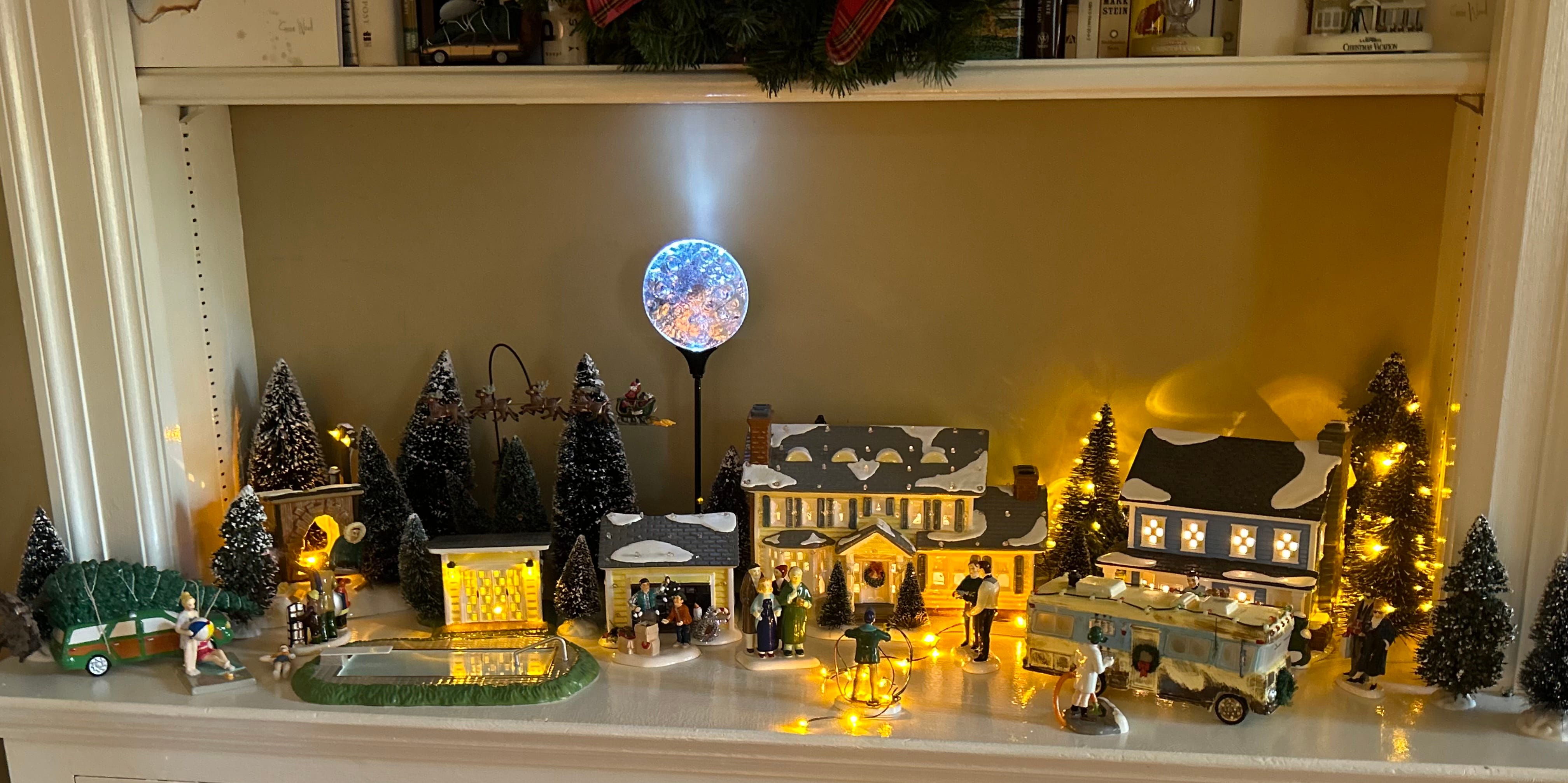
At some point, my affection for the film became material.
I own the full Christmas Vacation snow village. The Griswold house. The RV. The garage. The yard. It glows on my sideboard each December like a porcelain terrarium, frozen in permanent suburban crisis.
I own the moose punch cups, because if a movie offers you a drinking vessel shaped like a joyful woodland creature, you show respect.
And I own every Hallmark Christmas Vacation ornament ever produced.
Clark on the ladder.
Eddie with the hose.
The exploded turkey.
The squirrel.
The station wagon with the tree.
I didn’t set out to collect them. They simply gathered around me the way traditions do. Quietly. Persistently. Inevitably.
These objects aren’t kitsch.
They’re evidence.
They say: I lived long enough to find this funny. I survived enough Christmases to understand the joke isn’t cruelty.
It’s recognition.
The Advent House: A Decoration, a Quest, a Quiet Theology
There is a small but crucial object in Christmas Vacation that almost no one talks about.
The Advent House.
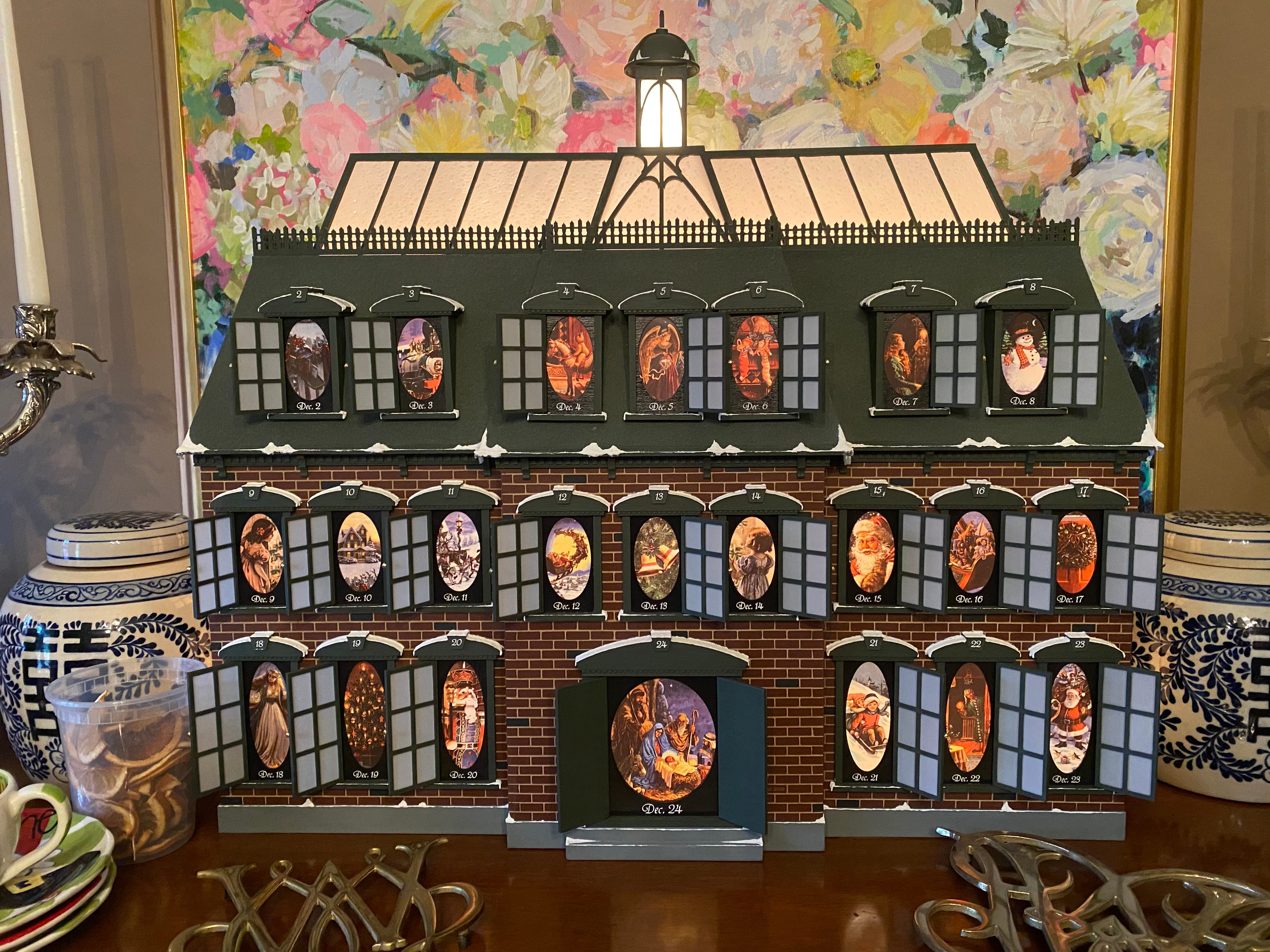
It sits on a sideboard. It’s lit from within. It doesn’t move. Each day in December, one tiny window opens until Christmas arrives.
Some Advent houses hold candy. Some hold trinkets. This one holds vintage Christmas images. Old Santas. Snowy streets. A slow reveal.
In the movie, the kids open a window each day. Nothing explodes. Nothing goes wrong. No punchline. Just a small, steady ritual that exists entirely outside Clark’s chaos.
That detail mattered to me more than I realized.
Years later, my desire for that Advent House turned into something unhinged. A man online promised replicas. Deposits were paid. He disappeared.
Clark would have understood.
Eventually, through a Christmas Vacation forum—the kind that predated Reddit and rewarded persistence rather than algorithms—I found someone who built them by hand. With reverence. With restraint.
In South Carolina.
Ten minutes from where I grew up. It felt improbable enough to be meaningful.
I ordered one immediately, then waited. Weeks. Months. It was finally ready in October. I asked my mother to pick it up so I wouldn’t have to pay shipping. She laughed, but agreed.
When she walked into the workshop and saw it, she bought one for herself.
Not because she needed it.
Because she recognized it.
Today, my Advent House sits glowing through December. Hers sits in her dining room, dignified and exact. And occasionally, my younger niece or nephew opens the windows, blissfully unaware of the mythology behind them.
Magic doesn’t need an origin story.
It just needs someone willing to open the next door.
Aunt Bethany and the Holiness of Chaos
One last piece of trivia, because John Hughes never missed a detail:
Aunt Bethany was played by Mae Questel, the original voice of Betty Boop.
The Griswold Christmas is literally blessed by American animation royalty.
It fits.
This movie is camp and chaos and sentiment in equal measure. So was my childhood.
My family Christmas was beautiful because it tried too hard. The Griswolds made me feel better about every Christmas that didn’t. And John Hughes gave us a holiday gospel about longing, love, and the wild, impossible hope that this year, finally, the lights will come on.
And usually, they do.
Further Reading
I keep a running collection of books that shaped this project on Bookshop.org.
Purchases there support independent bookstores—and help sustain this work.
Stay Connected
📖 Subscribe to Caleb Reed for weekly chapters and essays.
📸 Follow along on Instagram: @caleb_writes
📘 Facebook: Caleb Reed
🦋 Bluesky: @thecalebreed.bsky.social
I never knew a Christmas Vacation village existed. So funny!