

Island House
A first trip to Key West, and the moment I realized gay life had freedoms I hadn’t even imagined.

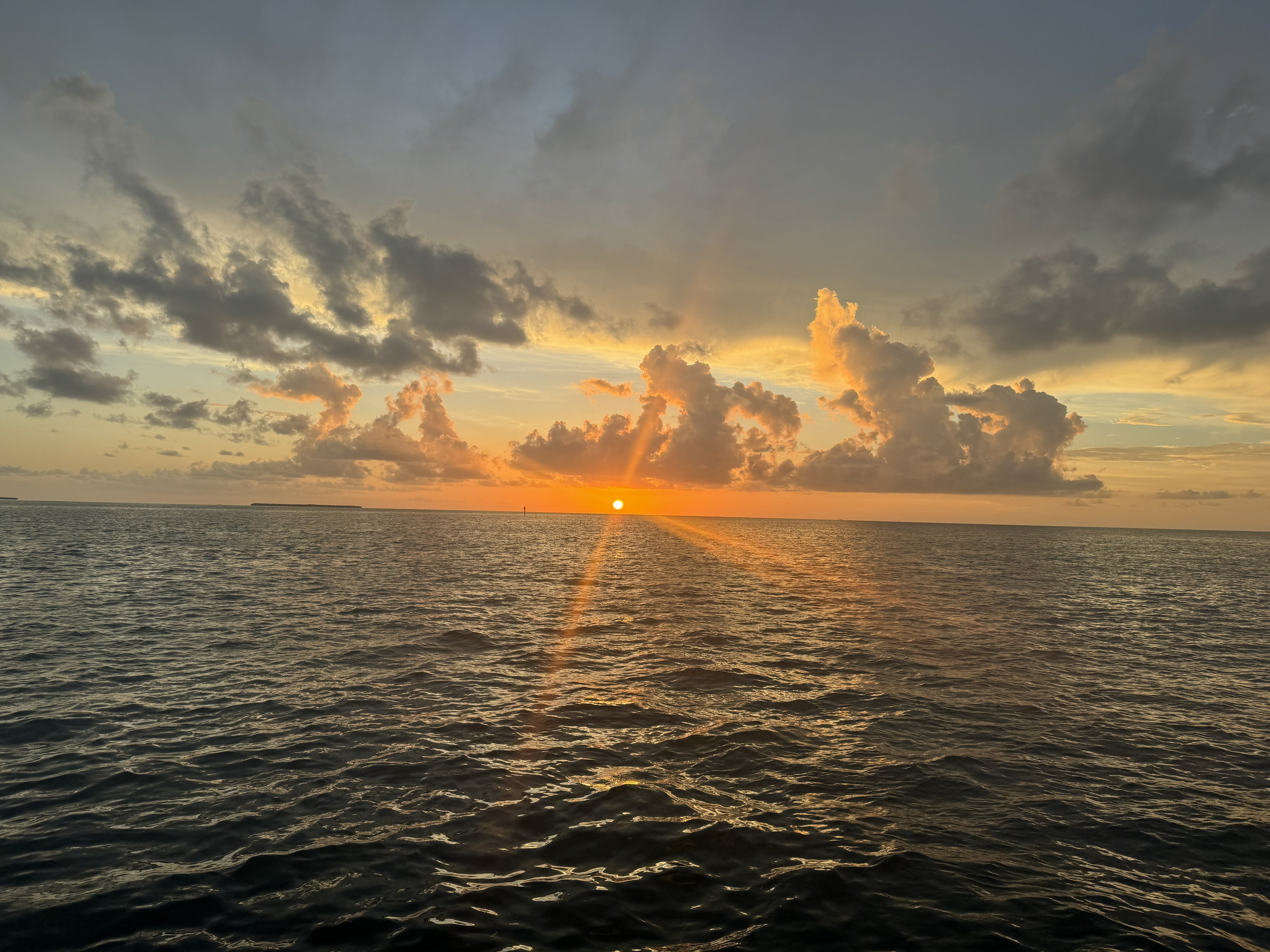
Firsts:
Author’s note: This is the third essay in a series about firsts and what it feels like to come out later in life. If you’re just finding this series, you may want to start with the earlier essays about my first hookup and my first trip to New York.


I had never visited the Florida Keys before, despite even living in Florida for about 3 years early in my marriage. I knew a couple of things about Key West:
Ernest Hemingway and his six-toed cats
The southernmost point of the continental U.S.
Chickens wandering the streets
And the fact that it was “gay,” according to my parents
It was that final point that stuck with me over the years.
In 2024, freshly out, in my first serious relationship with a man, and newly unemployed with a handsome severance package, I decided I was going to visit the gay meccas. P-Town was fun, but while I’m sure one can participate in as much debauchery as they want to, it’s not really just out in the open. Key West seemed the opposite, and more like what I was looking for.
Key West was the first time I stepped into a place where sex wasn’t just implied.
It was visible.
Not in a shocking or scandalous way. Just casually, the way other places might casually display cocktails or beach towels. It existed in the open air of the place, like humidity. Something everyone understood was part of the environment.
By the time I arrived there, I had already crossed a few personal thresholds. I had come out. I had had my first experiences with men. I had been to New York and felt what it was like to exist in a city where being gay was completely ordinary.
Key West, though, operated on a slightly different frequency.
This wasn’t anonymity or urban infrastructure. This was something closer to celebration.
Or maybe indulgence.
We stayed at Alexander’s Guest House, a charming gay guesthouse tucked into a quiet residential block. Directly across the street sat Island House, which had a very different reputation.
Island House is not subtle.
Even if you’ve never been, you’ve certainly heard stories. The website makes the tone clear. The photos feature beautiful men lounging around pools, perfectly tanned and impossibly fit, as if the entire property were populated exclusively by swimsuit models who also happened to be extremely relaxed about nudity.
It looked… intense.
When planning the trip, I had quietly decided it might be too much. My boyfriend at the time wasn’t particularly interested in the more open parts of gay culture, and I suspected Island House might feel overwhelming.
So we stayed across the street.
And then immediately bought day passes.
That ended up being the perfect arrangement. We could experience the place as much as we wanted, then retreat back to Alexander’s when we’d had enough.
Although, as it turned out, “enough” took longer than expected.
The first thing that struck me about Island House wasn’t the sex.
It was how normal everything felt.
The marketing photos suggested a pool deck filled with twenty-five-year-old fitness influencers. The reality looked much more like real life. Men of every age, shape, and body type lounged in the sun, talking, drinking, drifting between the bar and the hot tub.
Some were naked. Some weren’t.
No one seemed particularly concerned either way.
There were couples. There were friends. There were men clearly meeting each other for the first time. Occasionally someone would disappear inside or to a secluded area with someone else and then return later looking relaxed and slightly amused.
It was all incredibly matter-of-fact.
Standing there watching the rhythm of the place, I had a realization that surprised me.
I liked it.
Not the spectacle of it. The casualness.
People weren’t sneaking around or pretending something else was happening. They weren’t apologizing for their desires or hiding them behind layers of plausible deniability.
They were just… living.
And somewhere in the back of my mind I remember thinking, with a kind of quiet curiosity:
I could get into this.
The rest of the trip unfolded like a series of small discoveries.
One afternoon we went on a clothing-optional sailing trip with Blu Q Key West, which sounded far more daring in theory than it felt in practice. Once everyone had taken their clothes off and the boat was underway, it became surprisingly unremarkable.
A boat ride, some snorkeling, a little swimming.
With a lot more sunscreen.
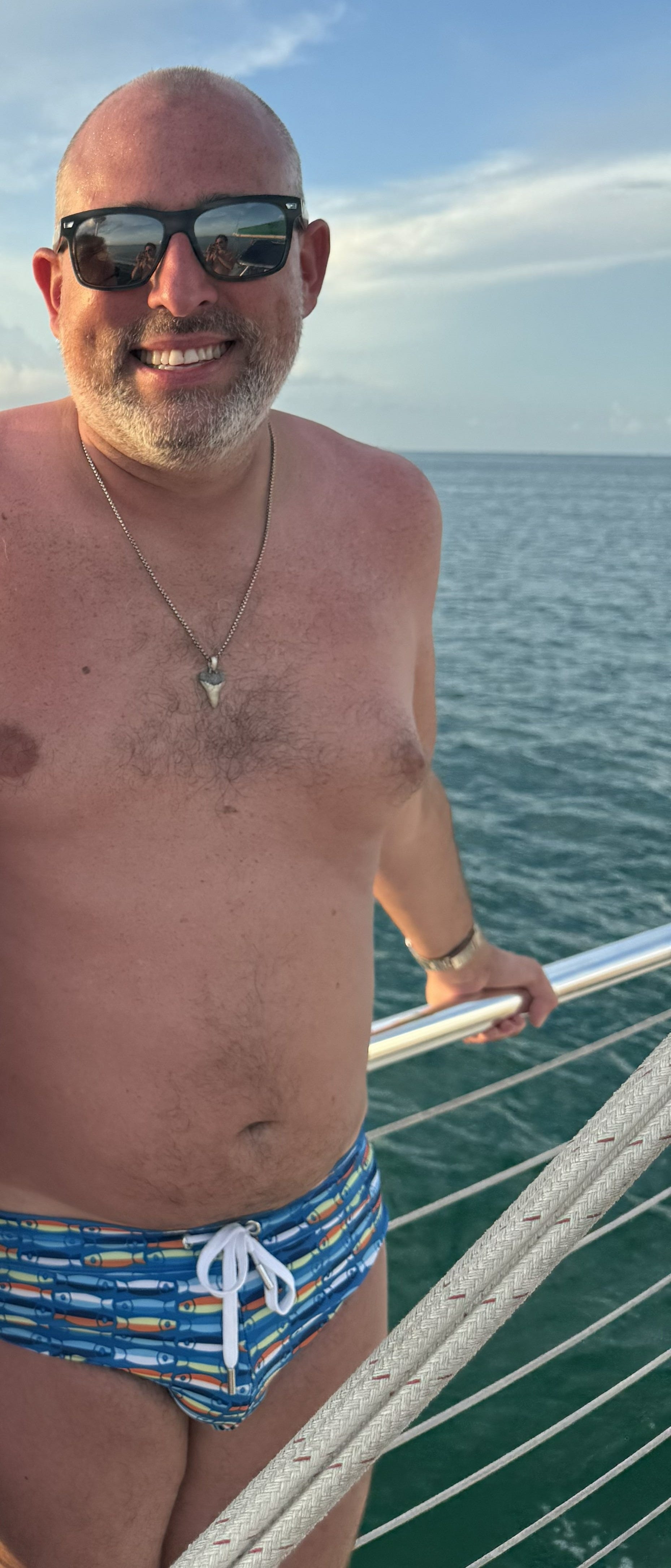
At one point the first mate leaned over the side of the boat while several passengers enthusiastically volunteered to help him with something that did not appear to be nautical in nature. The rest of us watched the horizon and pretended this was perfectly normal.
Which, apparently, it was. Though we had at least twenty years on most of the passengers, they made us feel welcome. They were there for a gay bachelor party and could easily have ignored us. Instead, they invited us to join them as they made the rounds on Duval Street.
Later that night we wandered through New Orleans House, where the deck overlooked the street and music spilled out into the humid air.
Again, the same feeling returned.
Not shock.
Recognition.
We came back the next day for the clothing optional pool and the impromptu naked water volleyball tournament.
What surprised me most was how comfortable I felt in my own skin there.
For most of my life, I had assumed that environments like this were built for people who looked nothing like me. Younger. Thinner. More perfect.
At the very least, they seemed much more comfortable with it than I was.
That assumption evaporated almost immediately.
The men around the pool didn’t look like the advertisements.
They looked like people.
Men in their thirties, forties, fifties, and beyond. Men with soft stomachs and receding hairlines. Men laughing with their friends or flirting badly at the bar.
Men who looked, in other words, a lot like me.
In talking to them, I found we had more in common than not. The man in the lounger next to mine (wearing nothing but a sharkstooth necklace) was an interventional radiologist. His partner a lawyer.
It was strangely liberating.
The realization crept in slowly but unmistakably: I wasn’t too old for this. I wasn’t too bald or too out of shape. These people weren’t the caricatures I’d been taught to imagine. I wasn’t outside the ecosystem I’d spent years imagining from a distance.
I could participate.
And that possibility changed something in me.
My boyfriend and I experienced the trip a little differently.
He was older and seemed to view the more open parts of Key West culture with a kind of amused detachment, as if it were something slightly beneath him. He wasn’t interested in playing with other people, and we had already agreed we were exclusive.
That part wasn’t a surprise.
What did surprise me was how much the environment awakened my curiosity.
Not recklessness.
Curiosity.
I wanted to explore the edges of this world. To understand how it worked. To see what it felt like to step fully into it, even briefly.
He seemed content to observe it from the outside.
That difference introduced a small but unmistakable tension between us.
At the time I didn’t fully understand what it meant.
Later, I would.
One night another couple staying at Alexander’s invited us to a gear night they were attending. Leather, harnesses, music, the kind of environment that once would have terrified me.
Instead, I found myself oddly calm.
This wasn’t the caricatured world I had imagined growing up. No one was trying to intimidate anyone else. People were friendly, welcoming, curious about one another in the same casual way people always are when they gather in spaces built for connection.
The entire culture operated on a kind of quiet consent.
People knew what they were there for.
And if you didn’t want to participate, you simply didn’t.
No one cared.
By the end of the trip, I realized something had shifted.
New York had shown me that it was possible to exist in the world as a gay man without being noticed or scrutinized.
Key West showed me something slightly different.
It showed me what it looked like when desire itself wasn’t hidden.
Where people gathered specifically to explore it, celebrate it, and occasionally indulge it a little more enthusiastically than they might at home.
It was a kind of freedom I hadn’t known existed before.
I also realized something else, standing by the pool one afternoon at Island House, watching the slow choreography of the place unfold.
I had spent most of my life assuming there was a narrow window for experiences like this. That if you didn’t figure yourself out in your twenties, the rest of the world would quietly move on without you.
Key West suggested otherwise.
People were arriving there at every age.
People were discovering things about themselves at forty, fifty, sixty.
The timelines were far less rigid than I had believed.
Eventually the trip ended, the way vacations always do. We packed our bags, flew home, and returned to our ordinary lives.
But something stayed with me.
Not the specific experiences, although those were certainly memorable.
It was the realization that entire worlds had been operating quietly alongside the one I thought I understood. Cultures, communities, and freedoms that had always been available if I had known where to look.
I had finally started looking.
And once you see that kind of possibility up close, it’s very hard to pretend it doesn’t exist.
Further Reading
II keep a running collection of books that shaped this project on Bookshop.org.
Purchases there support independent bookstores—and help sustain this work.
Stay Connected
📖 Subscribe to Caleb Reed for weekly chapters and essays.
📸 Follow along on Instagram: @caleb_writes
📘 Facebook: Caleb Reed
🦋 Bluesky: @thecalebreed.bsky.social