


The Coast
The drive down took ten hours, though Ethan stopped counting somewhere south of Petersburg.
Pine trees blurred into billboards — SOUTH OF THE BORDER, “YOU NEVER SAUSAGE A PLACE!” — until the air turned briny and flat. The wind through the cracked window smelled like home. Even the paper mill’s sour sweetness felt welcoming to Ethan.
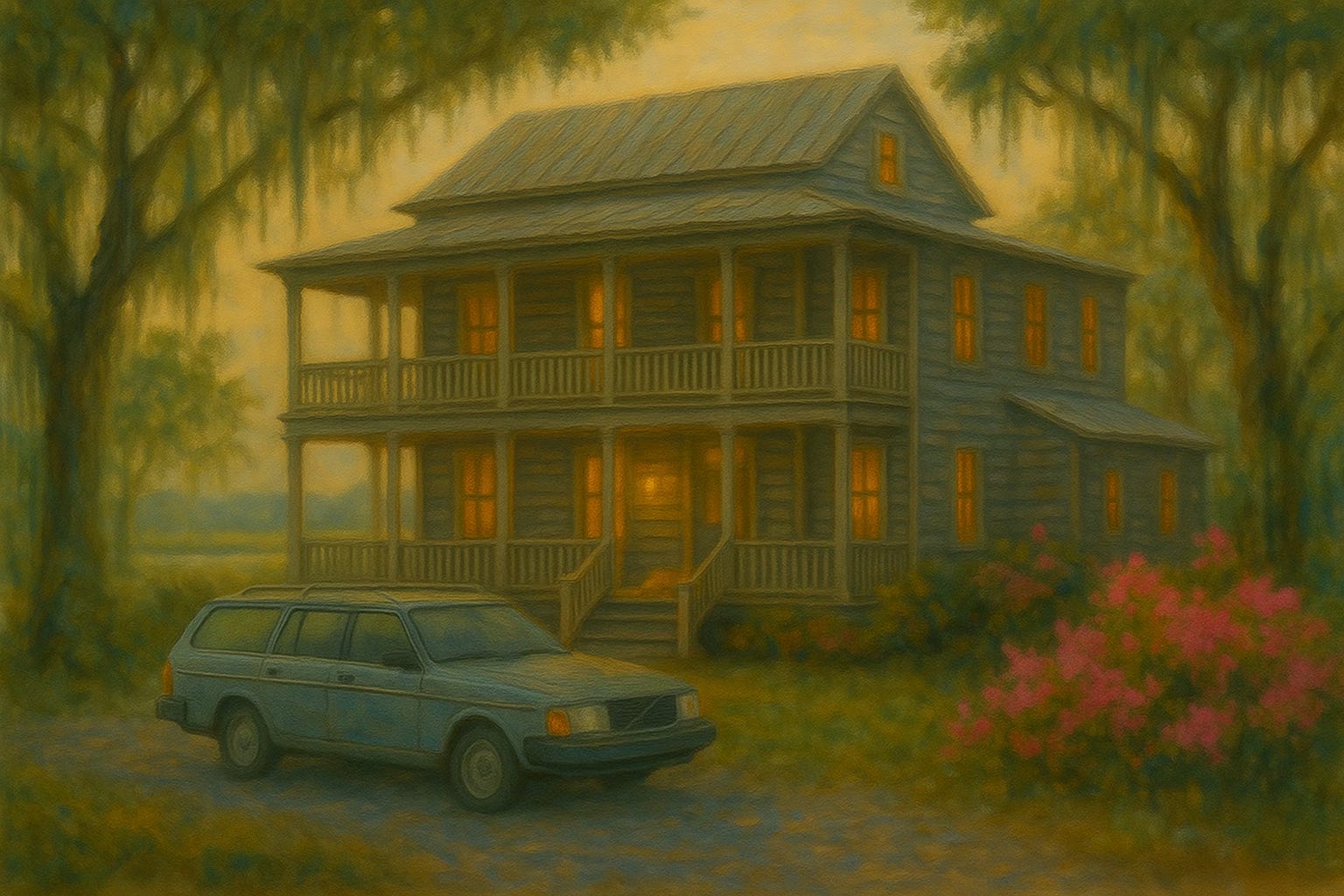
He pulled into the steel-slag driveway near dusk and parked in his old spot. The house looked the same: cypress siding bleached silver, porch fan clicking above wicker chairs, a spaniel asleep in the doorway like she had been waiting all year. Inside, the TV was tuned to Channel 5 and his dad was listening to the Charleston news. Ethan remembered when this anchor first started; now he was the “veteran.” Even though it was April, they were already talking about hurricane season.
“Just waiting for Walter Cronkite to come on!” his dad joked when he walked into the room, cocktail in hand.
It was an old one, but Ethan laughed anyway and sat down just in time for Dan Rather and the CBS Evening News.
By nightfall headlights cut across the marsh road. Jason’s old Volvo station wagon wheezed to a stop, throwing dust over the azaleas. Tyler climbed out first, shoulders loose, eyes rimmed red from the drive. Eli and Mark followed, half-laughing as they unloaded their bags from Eli’s car.
“Welcome to the beach, boys — fun, sun, and surf!” Ethan called out as he went to help them with their stuff.
Ethan’s mother greeted them with the same relentless warmth she used on Christmas guests. His father shook hands once and vanished toward the dock with the dogs. Dinner came fast — shrimp, cold beer, the tang of his mother’s cocktail sauce. Conversation rose and fell like the tide: Jason’s jokes, Tyler’s quiet laughter, Mark’s stories from home that no one corrected.
Afterward they moved to the porch, the night loud with frogs and the hum of the marsh, broken only by the occasional call of a bobwhite or whip-poor-will. The lamppost at the end of the steps threw a soft circle of light, catching the damp sheen on Eli’s arms. Even in early April, the humidity was thick.
“Your parents ever sell this place?” Jason asked.
“Not unless the creek dries up or my dad can’t fish anymore,” Ethan said.
“Then I guess you’re safe,” Tyler murmured.
The talk drifted to jobs, cities, the idea of futures that still felt hypothetical. Jason had interviews in Richmond; Tyler was planning to train with the NOVA contingent of the swim team over summer; Mark hadn’t decided on anything. Eli leaned against the railing, profile caught in the porch light.
“I start in August,” he said. “Bank on Madison Avenue. Catherine’s already apartment hunting.”
“New York,” Jason said, half-teasing. “You’ll hate the cold.”
“Maybe that’s the point.”
Ethan and Jason exchanged glances but remained silent. The sound of water under the dock filled the space for them.
“I’m going in for another beer — anyone need anything?” said Tyler, finally breaking the spell.
He returned with another round for each of them and finally sparked the joint he’d been waiting for since arriving. They passed it around and discussed their plans for the following day.
“Boat day!” they all chanted. Ethan finally relented. “I kinda figured that’s what you guys would say. We can use the jon boat and stick to the creeks, or we can take the Grady White my dad keeps at the marina in town. We’ll head up the river toward Bucksport and Conway.”
They talked for another hour or so, then called it a night.
Later, after the house went quiet, a sleepless Eli found Mark sitting on the dock with a beer balanced between his knees. The moon hung low over the creek; the tide had turned. Eli hesitated, then sat beside him.
“You ever think about how fast this all went?” he asked.
Mark smiled without looking up. “You sound like Mom.”
“I mean it. One minute I’m dragging you to high-school practice, next thing you’re a college kid with opinions.”
Mark laughed softly. “You still think I’m twelve.”
“No,” Eli said. He took a long drink, stared at the bottle’s reflection. “That’s the problem.”
Mark waited. The night hummed.
“I need to tell you something before it gets to you from somewhere else.”
Mark’s shoulders stiffened. “Okay.”
Eli exhaled smoke through his nose, watching it drift toward the water. “It’s about Ethan. Me and him.”
The words hung there, fragile as glass.
Mark blinked. “You and — what?”
“Something happened. It’s over. But I couldn’t keep sitting at the same table pretending.”
Mark’s voice cracked. “You’re joking, right?”
“I’m not.”
“Are you gay?”
He tipped the bottle, letting a trickle fall into the creek. “I don’t know. You don’t have to understand it. I just couldn’t lie to you anymore.”
“What about Ethan? Is he — ”
“You’ll have to ask him, Mark. He’s your roommate.”
Mark stood, breath shaking. “You’re unbelievable. What about Catherine and NYC? Did Ethan know about these plans before tonight?”
“I don’t know.”
“I can’t believe this — my brother and my best friend? Does anyone else know? Have you been with anyone else at Westmore?” His head was spinning.
He walked inside without slamming the door, which somehow hurt worse. Eli stayed where he was, staring at the thin ripples on the water until the beer went warm in his hand. The light above the dock burned steady as guilt.
Morning came slow, all glare and gulls. The tide was already pushing in by the time they loaded the coolers — sandwiches, beer, sunscreen that no one would reapply — into the car. Ethan’s father had left a note on the counter with the marina key: I called to let them know you guys were coming. She’s clean and full of fuel. Keep her in one piece.
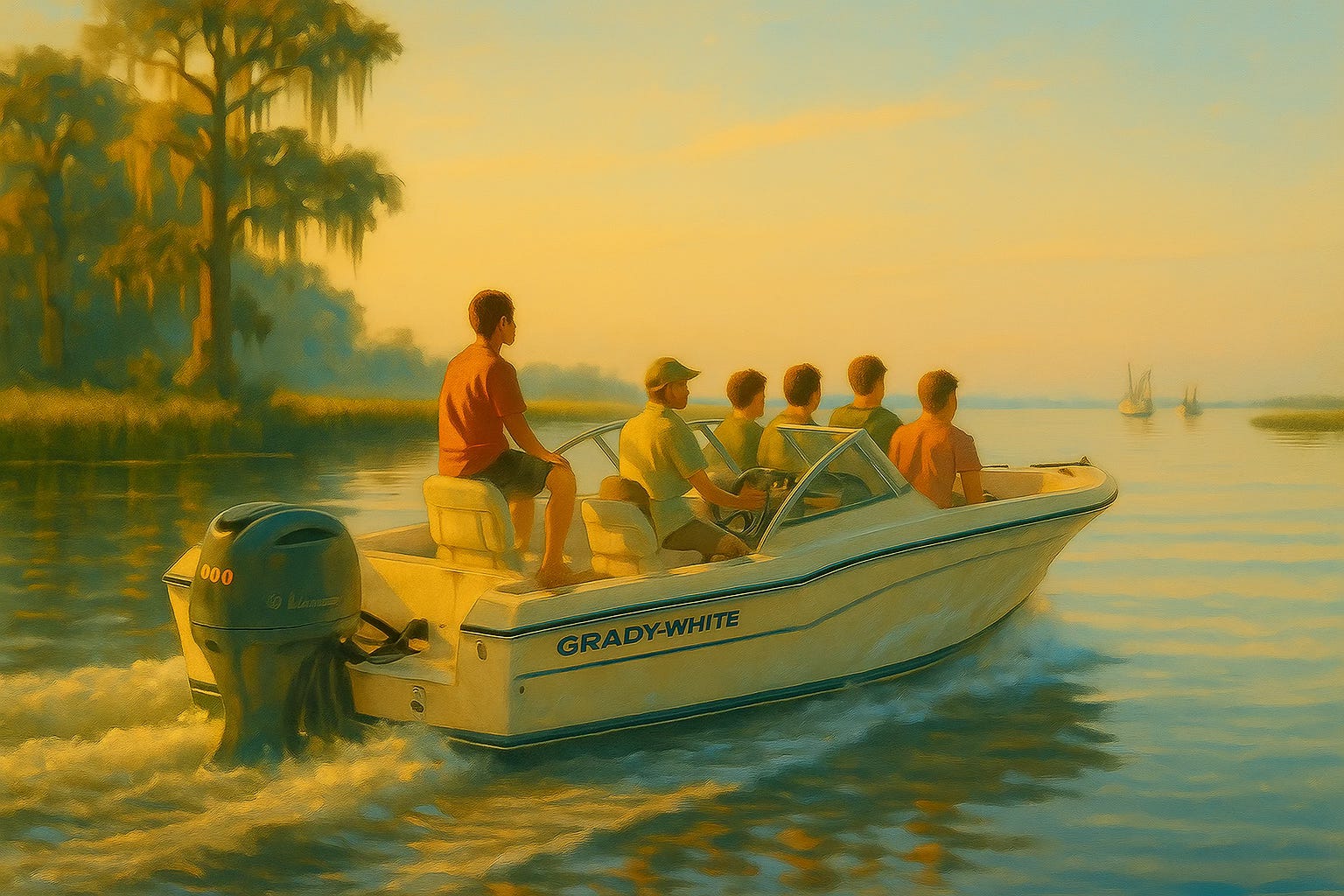
They eased out from the dock just after nine. Winyah Bay was glass, and the deep-V hull cut through the water with hardly a splash. The ghosts of old cypress rice trunks leaned into their reflections, and every turn of the channel smelled like salt and mud and gasoline. Jason handled the lines while Ethan ran the boat. Eli and Mark sat side by side near the bow, both wearing sunglasses, neither saying much.
“Feels like August,” Jason said, lighting a cigarette. “Even the air’s sweating.”
Ethan checked the depth finder, trying to remember if he was far enough from the sandbar across from the Coast Guard Station, glad for the noise of the engine. “We’ll go under the second bridge and catch the Waccamaw River. Once we hit the ICW it’s straight up to Myrtle.”
They followed the river east until it opened into the Intracoastal. Shrimp boats rocked at their moorings, nets hanging like tired flags. The current shifted under them, darker water sliding beneath the hull as they turned north. “Hang on,” Ethan said as he throttled down enough to get the boat on a plane, the hum of the outboard settling into rhythm with the slap of waves.
Eli stretched out his legs. “This beats the subway already.”
“Everything beats the subway,” Mark said flatly.
Ethan pretended not to hear. He pointed toward the horizon. “Barefoot Landing’s about two hours. We’ll grab lunch, head back with the tide.”
They passed small marinas and houses perched on stilts, the smell of marsh giving way to suntan lotion and fried food as they drew closer to civilization. Ethan pointed out each old rice plantation as they passed: Hobcaw, Arcadia, Hagley, Litchfield, Wachesaw. He knew them from memory, had watched them, save Hobcaw, transform into gated communities.
By noon they were idling into the docks at Barefoot, tying up between a rental pontoon and a tour boat painted with cartoon dolphins. The air shimmered with heat and the chatter of tourists.
At lunch — burgers, beer, the first real crowd they’d seen in days — the mood lightened. Mark flirted with the waitress; Tyler and Ethan traded stories about disastrous high-school summer jobs. Even Jason started to relax. Only Eli stayed quiet, sunglasses hiding his eyes, fingers tracing condensation on his glass.
“Ready to head back?” Ethan asked when the plates were cleared.
Eli nodded. “I’m driving.”
They untied and pushed off, the tide running in their favor. Afternoon light turned the water copper, the air heavy with the promise of a storm somewhere inland. Ethan took the wheel for a while, steering by instinct through the familiar bends. Jason dozed. Tyler watched the horizon, one arm draped along the seatback, close enough that Ethan could feel the warmth of him even in the wind.
Eli sat near the bow, facing the channel ahead. He looked back once, met Ethan’s eyes for half a second, then turned away again. Nothing was said, but the distance between them felt measured, like the space between two boats running parallel wakes.
By the time they reached the marina again, the sun had gone red behind the pines. The tide was high enough that the dock floated level with the deck. They tied off in silence.
“Good trip,” Jason said, stretching. “We didn’t sink, no one lost a finger. That’s success in my book.”
They laughed, thin and tired, gnats already biting their legs.
Back at the house, Ethan’s mother called them to dinner, her voice carrying through the salt air like something safe and ordinary.
Ethan’s mind lingered on the dock a moment longer, thinking about the ripples fading behind the Grady’s hull. For a day it had almost felt like old times — friends, laughter, the illusion that nothing had changed. But even in the quiet he could feel it: the tide had turned, and everything was moving out.
Dinner was the same ritual as every night home: shrimp and grits, bread still warm from the oven, Ethan’s mother asking polite questions that no one quite answered. Jason told a story about getting lost outside Richmond; Mark filled the silence with too much iced tea. Tyler kept catching Ethan’s eye and grinning like he was trying to make him laugh.
Eli stayed quiet, working on his second beer. When Ethan’s mother asked about New York, he gave the kind of careful answers that sounded rehearsed: Yes, Catherine’s excited. Yes, the bank is solid. No, it’s not as glamorous as it sounds.
She told him he’d do fine; he smiled like he already knew that part.
After dinner they drifted back to the porch. The air was still heavy, the marsh humming with insects. The dock light threw a gold track across the creek. Jason started a card game, Tyler fetched another round, and for a while the evening settled into an easy rhythm of jokes and half-finished stories. The sound of the fan above them ticked like a metronome.
Ethan tried to ignore the tension between the Bennett brothers — Mark laughing a little too hard at Jason’s jokes, Eli pretending not to notice. Everyone felt it.
By midnight the house quieted again. Doors shut. Footsteps faded upstairs. Ethan stood at the sink rinsing glasses, the last of the ice melting down the drain. Through the window he could see Eli outside, standing at the edge of the dock, cigarette ember flaring against the dark.
He thought about going out there, then didn’t.
Rain came through before dawn — soft, steady, the kind that makes the world smell new. When Ethan woke, the sky was still gray, the fan moving warm air in slow circles. Tyler was already up, barefoot, making coffee in the kitchen.
“Everyone sleep?” he asked.
Ethan nodded. “Mostly.”
“We going out in the boat again today?”
“I don’t think so. Maybe just the beach today. We’ll head back tomorrow.”
Tyler smiled. “You’ll miss this.”
“I always do.”
One by one the others appeared: Jason hunting for Advil, Mark still half-asleep, Eli last of all, already dressed, hair damp from a quick shower. Breakfast was quiet — eggs, toast, the dogs pacing for scraps. Outside, the rain had cleared; the marsh shone silver under a low sun.
Eli poured another cup of coffee and leaned against the counter. “We still boating?”
“No,” Ethan said. “Just a beach day. We’ll stay close.”
Jason clapped his hands. “Perfect. No work, no schedule, no expectations.”
They all laughed, but Ethan caught Eli’s eyes flick toward him — brief, unreadable — and felt something start to uncoil in his chest.
By late morning the air had already turned thick again, the kind of warmth that made everything slow. Ethan’s mother packed sandwiches and towels while the rest of them loaded the golf cart — a mint-green, gas-powered 1950s Cushman with a canvas top edged in faded fringe. It was a family heirloom more than a vehicle, brought down from his grandparents’ summer place and fitted with a rack for chairs and an old cooler that rattled with every bump.
“Beach club’s less than a mile,” Ethan said, tossing the last towel into the back. “You’ll see why my parents will never give this thing up.”
The Cushman rattled down the sandy road, tassels fluttering like tiny flags in the salt air. It coughed once, backfired like a shotgun, and kept chugging through the tunnel of live oaks and salt-bitten palmettos, past houses built for another time. At the Beach Club gate Ethan gave his name, and the arm rose without a pause. The attendant just laughed at the next backfire.
“Charge it to account two-oh-two-one — Harris,” Ethan said at the cabana desk, and the man nodded without a word.
The beach spread out white and empty, the tide still low, the pool deck glittering beyond the dunes. They staked out a cabana and fell into easy habits — Tyler ordered drinks, Jason claimed the nearest lounger, and Mark and Eli disappeared toward the water with surfboards that hadn’t seen wax in years.
Ethan sat for a while, watching the brothers wade out together, neither quite meeting the other’s eye.
Tyler leaned over. “They’ve been weird since the other night,” he said quietly.
“Yeah,” Ethan answered. “Something’s off.”
After a few minutes he stood. “Let’s take a walk.”
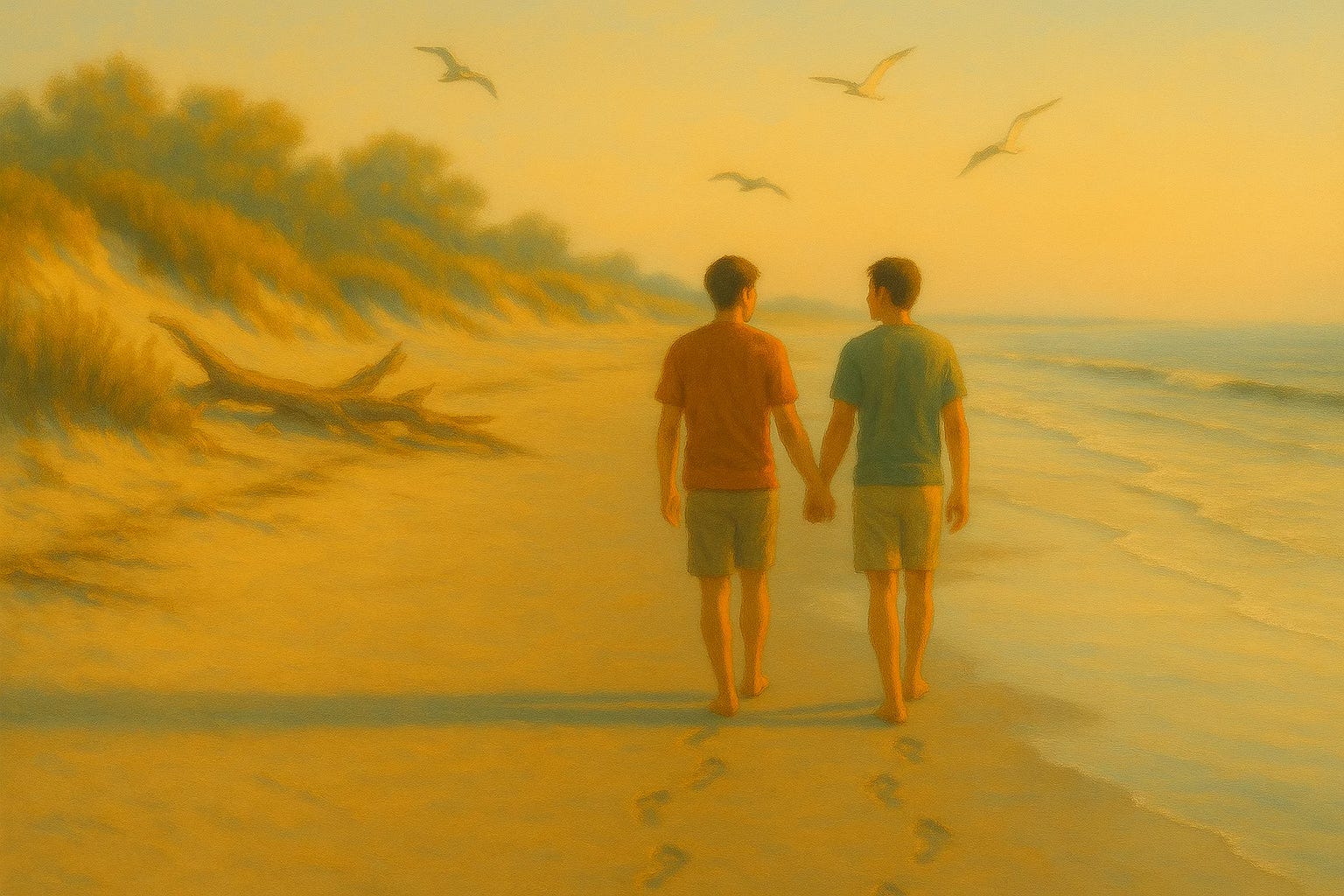
They left the towels and coolers behind and headed north along the beach, the sand firm and cool near the waterline. Gulls wheeled overhead, their shadows flickering across the dunes. The only footprints ahead of them belonged to crabs.
“I can’t believe this is where you grew up,” Tyler said finally.
“No big deal. My parents moved here when they first developed the place. It didn’t look like this then.”
“Still beats the bowels of Northern Virginia.”
Ethan smiled but didn’t answer. Tyler changed the subject. “You think Eli and Mark are okay?”
“They’ll figure it out. They always do.”
They walked in silence for a while, the wind flattening their shirts against their backs. Past the last house the beach curved inward, the surf softening into the rush of the tide through the inlet.
Ethan pointed across the water. “That’s Hobcaw Barony. See that old shed? During the war they used it to winch anti-submarine nets in and out of the water.”
A rust-red shape broke the surface nearby. “And that’s the Boiler,” he said when he noticed Tyler looking at it. “Old steam engine. We fish for sheepshead there. Tough bastards — Dad used to say they’d bite your finger clean off.”
Tyler laughed. “I’ll take your word for it.”
Past the driftwood forest the coast curved to the right, and North Inlet opened before them, North Island hazy across the channel.
“This place gets to you,” Tyler said. “Everything looks the same, but it isn’t.”
Ethan nodded. “That’s the trick. You leave thinking you’ll come back to the same day.”
The sun caught the water just right, turning it white-gold. Without thinking, Tyler reached for his hand. Ethan didn’t pull away. They kept walking, hands brushing at first, then joined, the only movement in the wide, bright silence.
At the bend where the inlet met the sea, Tyler stopped. For a long moment they just stood there, the wind between them. Then he leaned in, a quick, certain kiss — barely more than salt and sunlight.
When they pulled back, Ethan smiled. “We should head back.”
“Yeah,” Tyler said, still grinning. “Before someone puts another round of drinks on your account again.”
They turned south, the cabana flag already a bright speck in the distance, the tide climbing after them.
By late afternoon the sun had gone soft, the kind of light that made the marsh look painted. They rattled back down the sandy road in the old Cushman, skin tight with salt and sunscreen, towels flapping like pennants from the back rack. The house appeared through the trees the same way it always had—half hidden, porch light already on, fan turning lazily above the steps.
Inside, the air-conditioning hit like a wave. Everyone peeled off toward showers, leaving a trail of sand and damp clothes. Ethan heard the pipes groan upstairs, the bathroom doors closing in sequence, the house settling into its evening rhythm.
His mother had left lemonade and a note on the counter—Dinner at seven. Shrimp again.—and a pie cooling beside it. Tyler was already barefoot on the porch with a beer, the newspaper folded beside him. Jason stretched out on the couch, half asleep, the dogs snoring at his feet.
Mark was nowhere to be seen; Ethan guessed he’d gone for a drive. Eli was upstairs. The sound of running water stopped, then started again.
Ethan poured a glass of lemonade, leaned on the counter, and watched the creek through the kitchen window. The tide was turning, pulling the day back out with it. For the first time since they’d arrived, the house felt too quiet—like something waiting to happen.
He set the glass down and went outside, meaning only to walk the dock before dinner. The boards were still warm under his feet, the air thick with the smell of salt and cut grass. Halfway down, he stopped. Eli stood at the end of the dock, barefoot, hair damp, cigarette in hand.
He turned when he heard the door open, but Ethan just waved, deciding not to join him.
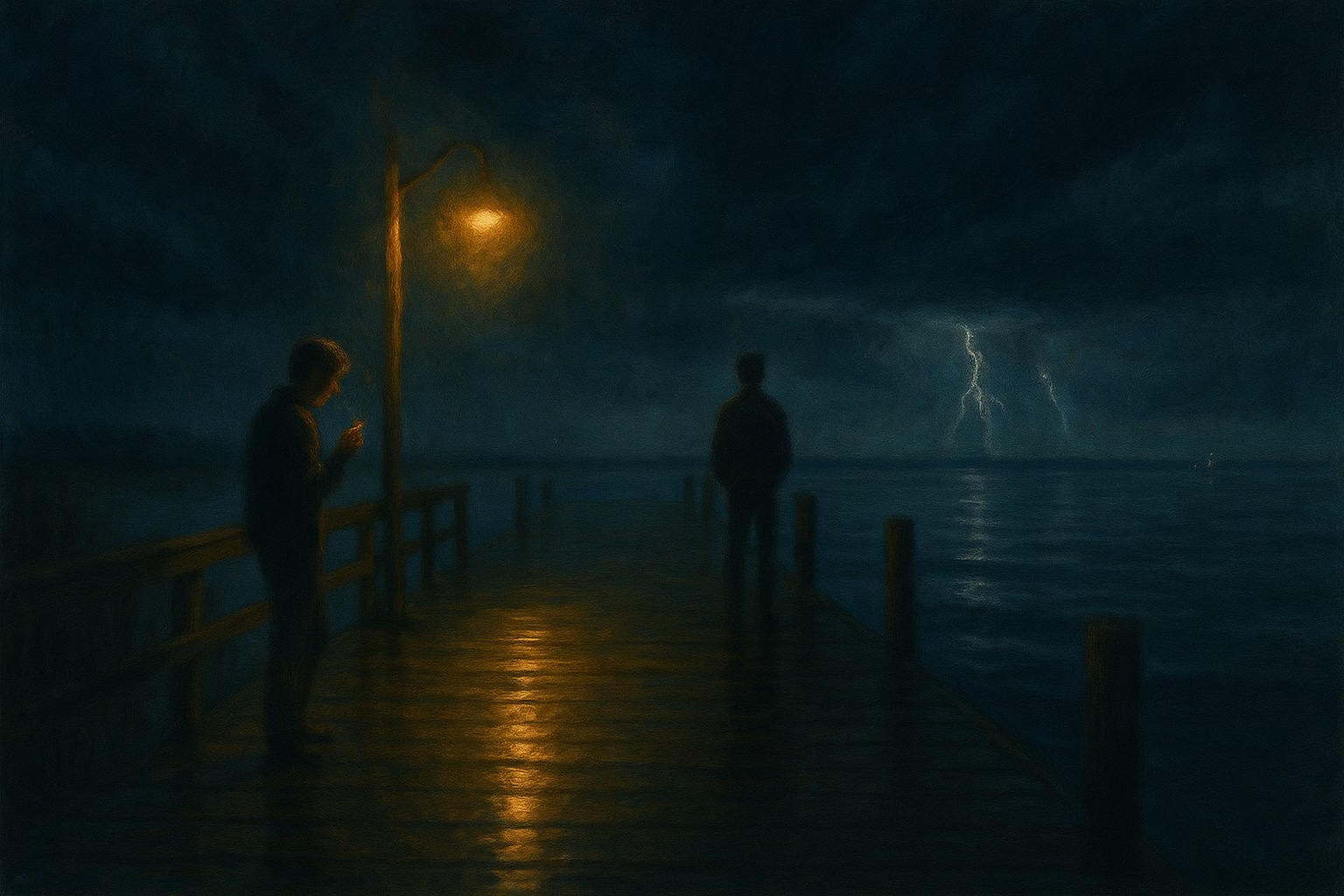
That night, Ethan couldn’t sleep. The house felt too still, the kind of silence that follows something breaking. He heard a creak in the hallway and thought it was his father, but when the shadow moved it was Eli—barefoot, t-shirt, cigarette behind his ear.
“Can’t sleep,” Eli said.
“Neither can I.”
They stepped outside again. Clouds had rolled in; lightning flickered far offshore. The air smelled of rain and cigarettes.
“You know this is the last time,” Eli said.
“Yeah.”
“I wish I’d met you somewhere else.”
“You wouldn’t have liked me somewhere else.”
“You’re wrong about that.”
The kiss started small, a release more than a spark. When they moved to Ethan’s room, the floorboards whispered underfoot. The storm held off just long enough for the windows to fog with breath. It wasn’t hungry anymore; it was mercy.
After, Eli sat at the edge of the bed, head in his hands.
“I told him,” he said.
“Told who?”
“Mark.”
Ethan froze. “Why?”
“Because I couldn’t stand pretending he didn’t already know. Because I’m tired.”
He looked back, eyes rimmed red. “You should hate me for it.”
“I don’t,” Ethan said.
Outside, thunder rolled across the marsh.
Eli lay down beside him, arm draped over his chest. “I can’t keep being this person twice.”
“Then don’t.”
Neither spoke again.
By morning Eli was gone. Only a note remained on the nightstand: Thanks for the quiet.
The handwriting looked steady.
Fog wrapped the yard, soft as gauze. Tyler stood on the porch, coffee in hand, watching the tide.
“You’re up early,” Ethan said.
“Couldn’t sleep.”
They watched the fog thin into morning.
“He’s gone,” Ethan said.
“I know.”
Tyler handed him the mug, eyes gentle. “You okay?”
“Ask me tomorrow.”
From inside came Jason’s voice, calling for coffee filters, Mark answering short, flat.
The house woke itself piece by piece, unaware that something had already ended.
When they left that afternoon, the road shimmered with heat. The spaniel barked once from the porch, then settled back down in the shade.
By the time the highway shouldered them north, the marsh light was gone and the radio had turned to static.
Westmore waited ahead, still green with spring and humming with endings.
Further Reading
I keep a running collection of books that shaped this project on Bookshop.org.
Purchases there support independent bookstores—and help sustain this work.
Stay Connected
📖 Subscribe to Caleb Reed for weekly chapters and essays.
📸 Follow along on Instagram: @caleb_writes
📘 Facebook: Caleb Reed
🦋 Bluesky: @thecalebreed.bsky.social
Great chapter. I actually felt for Eli.